

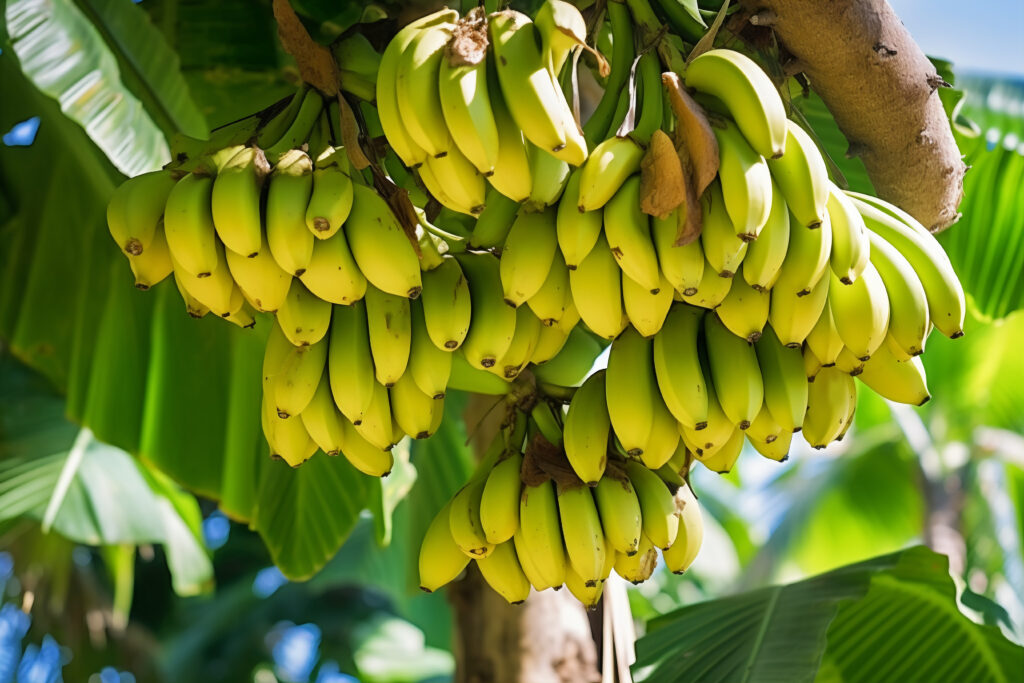
Brazil is the fourth largest producer of bananas in the world. The banana tree (Muse (cvs.) is cultivated in all states of the country, and its fruit is one of the most popular and consumed in Brazil. However, the crop faces several phytosanitary challenges, especially related to diseases caused by fungi, bacteria, viruses, and nematodes, which lead to losses in production and fruit quality (Gurgel et al., 2010). Among these diseases, yellow sigatoka stands out (Mycosphaerella musicola, Leach), the black sigatoka (Mycosphaerella fijiensis, Morelet) and Panama disease (Fusarium oxysporum f. F. sp. cubense) (Cordeiro et al., 2004; Cordeiro et al., 2005). These problems are aggravated by the predominant use, by Brazilian producers, of varieties from the Cavendish (such as Prata, Nanica, Nanicão and Grand Naine) and Maçã subgroups, which can be highly susceptible to these diseases.
Although the use of resistant varieties is an important alternative, other management measures are also essential. Malavolta (2006) points out that well-nourished plants tend to show lower incidence, severity, and damage caused by pests and diseases. The plant's susceptibility to diseases is influenced by the nutritional imbalance of macro and micronutrients, which ultimately reduces the defense response. Thus, some preventive measures are recommended, including keeping plants well-nourished. For Panama disease, for example, studies highlight the importance of a good ratio between potassium, calcium, and magnesium, in addition to adequate soil pH correction (Cordeiro, 1997; Cordeiro et al., 2004; Trindade et al., 2002). For yellow sigatoka and black sigatoka, balanced fertilization, mainly with potassium and organic matter, are practices that contribute to ideal levels of control (Trindade et al., 2002). This is because, in well-nourished plants, rapid leaf emergence is observed, in addition to improvements in physical and chemical resistance barriers and better expression of resistance, especially horizontal resistance (Freitas et al., 2013).
Studies conducted in Brazil reinforce the correlation between the nutritional status and health of banana plantations. The cultivation of Prata Anã and Branca bananas in Santa Catarina, in soils with low pH values and levels of Ca, Mg, and Zn, showed a high incidence of wilting caused by fusarium wilt (Malburg et al., 1984). In Bahia and Espírito Santo, areas with reports of this disease presented reduced pH and levels of Ca, Mg, and Zn, as well as high K/Ca and K/Mg ratios (Embrapa, 1987). In Paraíba, the incidence and severity of Panama disease in the Pacovan cultivar were mainly related to pH and levels of Ca and Al in the soil, with acidic pH and low levels of Ca and Mg being associated with diseased plants, as well as unfavorable ratios between K/Mg, Ca/Mg, and Ca/K (Lopes et al., 2008).
These data reinforce the importance of maintaining banana plantations with balanced nutrition, favoring the productivity and quality of the fruit. The use of technologies has been increasingly decisive for the success of agriculture, from the choice of varieties to post-harvest management, including crop nutrition (Ferreira, 2015). Furthermore, consumer markets are more demanding regarding food safety, increasing the demand for fruits produced in sustainable systems, based on good agricultural practices that ensure product traceability (Ferreira, 2015).
The solutions offered by ILSA contribute to efficient and balanced nutrition of banana plantations and to the sustainability of production, adding value to the products. FERTIL is a fertilizer characterized by the presence of a high content of organic N (12.5%) and amino acids from AZOGEL® (hydrolyzed protein of animal origin). FERTIL also contains organic carbon (40%), which enhances microbial activity and soil health, with organic nitrogen, which can be assimilated for longer, allowing for balanced vegetative development, and lower losses of mineral nutrients due to the protective action of high CEC organic matter, improving the efficiency in the use of phosphorus, potassium, molybdenum, boron, iron, zinc and manganese. In addition to its nutritional potential, FERTIL acts on the health of the soil and plants. Bioanalyses performed after the application of FERTIL identified a lower incidence of the pathogen Fusarium, a soil fungus that, among other diseases, can cause Panama disease in banana plantations.
Bibliographic references
Cordeiro, ZJM et al. Banana Cultivation. Crus das Almas: Embrapa Mandioca e Fruticultura, p. 146-182, 2004.
Cordeiro, ZJM et al. Diseases of banana (Musa spp.). In: Kimati, J. et al. Manual of Phytopathology: Diseases of cultivated plants. São Paulo, SP: Agronômica Ceres, 2005, p. 99-117.
Cordeiro, ZJM. Diseases. In: ALVES, EJ, org. The banana crop: technical, socioeconomic and agro-industrial aspects. Brasília: EmbrapaSPI/Cruz das Almas: Embrapa-CNPMF, 1997, p. 353-408.
Embrapa. Brazilian Agricultural Research Corporation. National Cassava and Fruit Research Center. Cruz das Almas, BA. Technical Report of the National Cassava and Fruit Research Center, 1987.
Freitas, AS et al. Severity of banana yellow sigatoka as a function of mineral nutrition in nutrient solution. XX International Meeting of the Association for Cooperation in Research and Integral Development of Musaceae. Fortaleza, Ceará, 2013.
Ferreira, CF. The banana agribusiness. Brasília, DF: Embrapa, 2015. 832 p.
Gurgel, LMS et al. Banana Production System for the Zona da Mata of Pernambuco. Aracajú: Embrapa Tabuleiros Costeiros, Recife: IPA, p. 75-94, 2010.
Lopes EB et al. Influence of soil chemical factors on the incidence of Panama disease in banana cv. Pacovan in Paraíba. Journal of Biology and Earth Sciences, v. 8, p.100-109, 2008.
Malavolta, E. Manual of plant mineral nutrition. São Paulo: Editora Agronômica Ceres, 2006. 638p.
Malburg JL et al. Survey of the nutritional status of Santa Catarina banana plantations. Proceedings of the 6th Brazilian Congress of Fruit Growing. Florianópolis SC. Brazilian Society of Fruit Growing, v. 1, p. 256-275, 1984.
Trindade, DR et al. Banana Diseases in the State of Pará: Introduction. Embrapa: Belém, Pará, technical circular no. 27, 2002.
Authors
Agr Eng. MSc. Isabela Bulegon Pilecco
Agricultural Eng. Msc. Thiago Stella de Freitas
Agricultural Engineer Tuíra Barcellos