


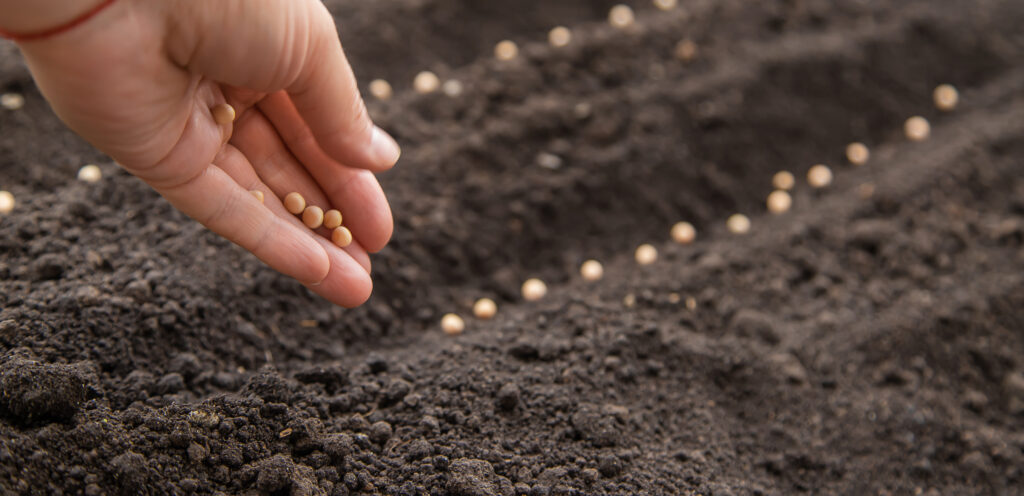
The population of established plants in crops is one of the main components of crop productivity, being strongly influenced by the density and quality of the seeds used. For soybeans in Rio Grande do Sul, a productivity plateau was identified at densities between 22 and 31 plants m², with a loss of 187 kg ha⁻¹ for each plant below 22 (Winck et al., 2023). In corn, in the state of Santa Catarina, the established plant population was identified as the main differentiating factor between high and low productivity crops (Pilecco et al., 2024). These results reinforce the importance of strategies that ensure germination and seedling establishment, minimizing the negative effects of low-quality seeds or adverse conditions at the time of germination and emergence.
The use of seeds with high physiological quality positively influences the initial development of the crop (Scheeren et al., 2010; Tavares et al., 2013). On the other hand, seeds with low vigor show less resistance to adverse conditions, which can compromise final productivity (Albuquerque and Carvalho, 2003). In this context, the use of seed treatments (ST) is becoming increasingly relevant.
Among the alternatives to improve the performance of seeds and plants in the field, the use of amino acids stands out. These organic molecules, which contain one or more amine groups, are basic constituents of proteins and precursors of substances that regulate plant metabolism (Floss and Floss, 2007). Their application is not aimed at meeting the demand for protein synthesis, but at activating the physiological metabolism of plants, playing an important anti-stress role.
Research on the use of amino acids in seed treatment indicates that, for lots of high physiological quality, there is no significant effect of the treatment (Door, 2016). However, for seeds of intermediate or reduced quality, the use of seed treatment containing amino acids reduced the rate of accelerated seed aging. In maize, Coelho (2011) observed that seed treatment with amino acids resulted in faster emergence, fewer dominated plants, greater root growth, and an increase in grain yield. Ramirez et al. (2024) found that the application of amino acids in seed treatment mitigated the effects of stress on the initial development of seedlings. In supersweet maize under water stress, Carmo et al. (2021) also observed benefits, including greater tolerance to water deficit and high temperatures. For soybeans, an increase in shoot dry mass was identified with the application of amino acid-based biostimulant in seed treatment (Tatto et al., 2018).
Composed of ILSAMIN Potente, ILSAMIN RADIX, and ILSAMIN CoMo, Crop Start-up is ILSA's management strategy that enables maximum expression of genetic potential while mitigating damage caused by abiotic stresses in the first phase of plant development. Both are formulated from the organic matrix GELAMIN, a natural source of rapidly absorbed amino acids. Thus, they have a nutritional and stimulating effect on the physiological processes of plants, favoring and accelerating rooting.
ILSAMIN Radix and ILSAMIN Potente provide plants with amino acids, humic substances, and an auxin inducer, promoting root development and thus maximizing water and nutrient uptake. The difference is that ILSAMIN Radix is indicated for seed treatment (ST) and ILSAMIN Potente for application in the planting furrow. In addition to the amino acids from GELAMIN, ILSAMIN CoMo contains the micronutrients cobalt and molybdenum in its formulation. The use of micronutrients in ST allows for greater uniformity of application and reduced operational application costs, making it important to ensure that the amount applied is sufficient to meet the plants' requirements throughout the entire cycle (Pereira et al., 2012).
In soybeans, ILSAMIN CoMo enhances biological nitrogen fixation, favoring both the development of nitrogen-fixing bacteria and the transformation of atmospheric nitrogen into assimilable forms. In corn, studies show that fertilization with Mo can increase nitrogen content in leaves (Leite, 2020) and increase protein levels in grains by up to 3% (Ferreira et al., 2001), bringing economic and productive benefits, especially in high-potential crops (Picazevicz, 2017). This occurs because molybdenum participates in electron transport and is a component of key enzymes in the nitrogen cycle (Aguilar, 2017; Santos et al., 2020). Application can be done via seeds, soil, or foliar application, all being effective. However, it is important to be careful with the dose used in seed treatment, since very high doses in seeds can compromise the physiological quality of the seeds (Pereira et al., 2012).
Thus, in general, research results demonstrate that amino acids can contribute to better seed performance and crop establishment, especially under adverse conditions. However, their effectiveness is related to factors such as the cultivated species, environmental conditions, dosage, and product composition, reinforcing the importance of management tailored to the specific characteristics of each crop.
Bibliographic references
AGUILAR, MAL. Doses and application times of Mo in sweet corn. 2017. 39 p. Dissertation (Master's in Plant Production) – Faculty of Agricultural and Veterinary Sciences – Unesp, Jaboticabal, SP, 2017
ALBUQUERQUE, MCF; CARVALHO, NM Effect of the type of environmental stress on the emergence of sunflower, soybean and maize seeds with different levels of vigor. Seed Science and Technology, vol. 31, p. 465-478, 2003
CARMO, MAP Biostimulants applied to sweet corn seeds and plants under abiotic stress conditions. Brazilian Journal of Development, v.7, n.3, p.31727-31741, 2021.
COELHO, AM. Agronomic Efficiency of Amino Acid Compounds Applied to Seeds and Foliar Spraying in Second-Crop Corn. Embrapa, Sete Lagoas. Technical Communication, no. 192, 2011.
DOOR, CS. Coating soybean seeds of different levels of physiological quality with amino acids: Plant performance in the field and seeds. Master's Thesis. UFPEL, 2016.
FERREIRA, AC B; SANTOS, J, L; LACERDA, D, P. Agronomic and nutritional characteristics of corn fertilized with nitrogen, Mo and zinc. Scientia Agricola, v. 9, 2001.
FLOSS, EL; FLOSS, LG. Latest generation organo-mineral fertilizers: physiological functions and use in agriculture. Revista Plantio Direto, n.100, 2007.
LEITE, AJ Effects of molybdenum application via soil on maize cultivation. 2020. 22p. Master's Dissertation. UFLA, 2020.
PEREIRA, FRS et al. Physiological quality of maize seeds treated with molybdenum. Brazilian Journal of Seeds, v. 34, n. 3, p. 450–456, 2012.
PICAZEVICZ, AAC. Corn growth in response to Azospirillum brasilense, Rhizobium tropici, Mo and nitrogen. 2017. 81 p. Thesis (Doctorate in Plant Production) – Federal University of Acre, Rio Branco, 2017.
PILECCO, IB et al. Potential and gaps in corn productivity in Santa Catarina. 1st ed. Santa Maria, 2023. 63p.
RAMIREZ, FR. Quality of maize seeds subjected to different doses of zinc and amino acids. Revista Contribuciones a Las Ciencias Sociales, v.17, n.3, p. 01-16, 2024.
SANTOS, MC et al. Corn cultivation with different doses and application times of Mo. Brazilian Journal of Development, Curitiba, PR, v. 6, ed. 2, p. 5393-5402, 2020.
SCHEEREN, BR; PESKE, ST; SCHUCH, LOB; BARROS, ACSA. Physiological quality and productivity of soybean seeds. Brazilian Journal of Seeds. v. 32, n. 3, p. 035-041, 2010.
TAVARES, LC et al. Performance of soybean seeds under water deficit: yield and physiological quality of the F1 generation. Ciência Rural. v. 43, n. 8, p. 1357-1363, 2013.
TATTO, L. et al. Performance of soybean seeds treated with biostimulant under different osmotic potential conditions. Electronic Scientific Journal, UERGS, v. 4, n. 3, p. 397–408, 2018.
WINCK, JEM et al. Decomposition of yield gap of soybean in environment × genetics × management in Southern Brazil. European Journal of Agronomy, v.145, n. 126795, 2023.
Authors
Agr Eng. MSc. Isabela Bulegon Pilecco
Agricultural Eng. Msc. Thiago Stella de Freitas
Agricultural Engineer Tuíra Barcellos