

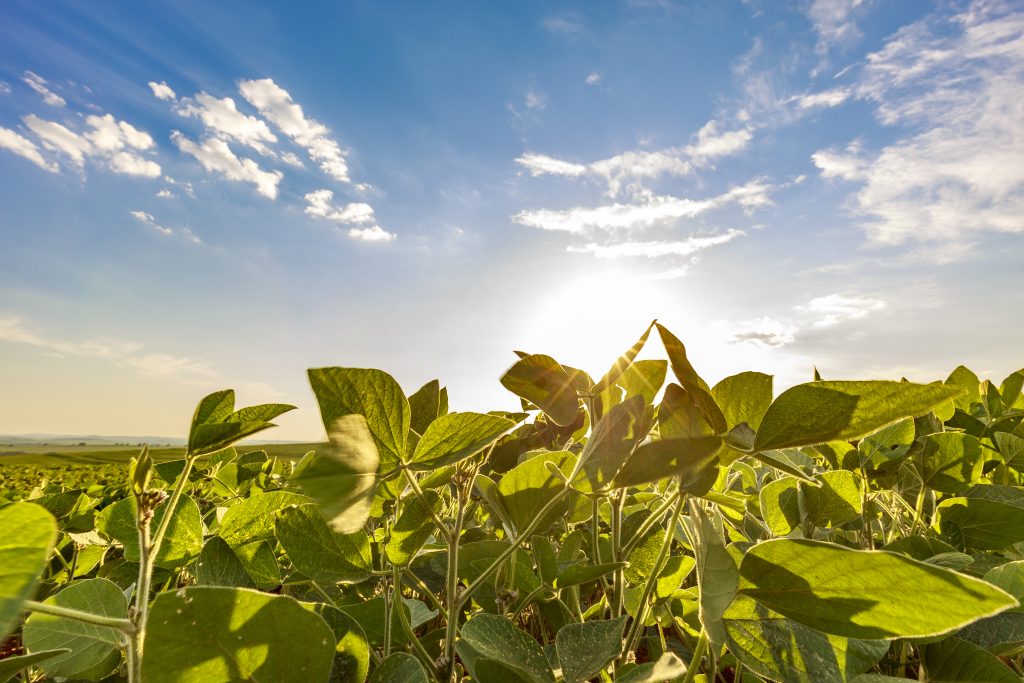
Soybeans (Glycine max(Potato) is the most produced legume in Brazil, being considered one of the agricultural crops that has grown the most in the last three decades, with a relevant cultivation area corresponding to more than 50% of all the area cultivated with grains in Brazil (ZAMBIAZZI et al., 2017) and, due to its profitability and its economic potential for commercialization in the national and international market, it is a crop of great economic importance for Brazil, being the commodity that stands out the most in Brazilian territory and one of the main crops of agribusiness (VINHAL-FREITAS et al., 2011; FRARE, 2020).
The technology incorporated into new cultivars plays a prominent role in increasing productivity, but the management practices adopted by producers in recent decades have been the biggest differentiator in placing the country among the largest producers (TAGLIEBER et al., 2022). In soybean cultivation, several nutrients are necessary to achieve good productivity levels, with phosphorus, nitrogen, potassium, calcium, and magnesium being the main ones with the greatest potential to influence production components (BORKERT, 2005). According to Coutinho et al. (2014), balanced doses of fertilizers should be supplied to meet the nutritional requirements of a given crop.
Among the most important nutrients for the soybean plant, potassium stands out as the second most extracted macronutrient, second only to nitrogen. Potassium is considered one of the most important in the pursuit of high productivity rates in various agricultural crops in Brazil (TAGLIEBER et al, 2022).
Potassium participates in enzymatic activation, regulates stomatal opening and closing, and acts in the osmotic control of tissues (MALAVOLTA, 2006). But in addition to all that has already been mentioned, potassium fertilization at correct levels can increase nodulation and consequently the number of pods and grains per plant, increases seed size and oil levels, and also performs various physiological functions in plants (PEREIRA et al., 2021).
Malavolta (2006) emphasizes that it is necessary to apply potassium intelligently, because, since potassium chloride has a high salinity index, it can harm or delay the germination and emergence of plants if the dose of potassium is too high near the plant roots. Studies carried out by Silva (2016) point to the need for caution regarding the excessive application of potassium chloride, since this can promote the residual accumulation of K.+, thus harming the characteristics of the soil, and consequently, the agricultural crop in question.
Potassium chloride (KCl), the main source of potassium used in Brazilian agriculture (VILELA et al., 2004; LOPES, 2005), is a highly water-soluble salt (58% solubility) and can be easily leached (RESENDE et al., 2006). However, with advances in fertilizer production technology, processes are being sought to control the rate of nutrient release, promoting lower losses and better adaptation to tropical conditions (MARTINS et al., 2008). However, research aimed at increasing the efficiency of this nutrient utilization focuses only on the study of application methods, not evaluating different fertilizers or technologies that modify the solubility of the KCl source (LEAL et al., 2015).
Potassium fertilization can be carried out either in the sowing furrow or broadcast (BORKERT et al., 2005), with broadcast application before sowing being preferably recommended in clayey soils with medium to good potassium levels. Regarding the application of potassium (in the form of KCl) in the sowing furrow, due to the high salinity index, some precautions are recommended when using this fertilizer (SILVA and LAZARINI, 2014). Among them, do not apply doses exceeding 50 kg ha⁻¹.-1 of K2The application of water in the sowing furrow aims to reduce the risks of saline effects on seed germination, especially under water stress conditions (OLIVEIRA et al., 2008).
New technologies aim for the gradual or controlled release of nutrients, so that they are made available according to the crop's absorption rate, mitigating losses due to leaching, making it possible in some cases to reduce doses and, mainly, increase utilization efficiency (LEAL et al., 2015). These products can be called next-generation fertilizers and constitute one of the most modern land fertilization techniques (SOUZA, 2010). According to Trenkel (2010), these types of fertilizers are classified as slow- and controlled-release fertilizers and stabilized fertilizers. Slow- and controlled-release fertilizers are characterized by the release of nutrients over several months, and stabilized fertilizers are those associated with urease and nitrification inhibitors in the case of nitrogen sources (LEAL et al., 2015).
In soil, there are different factors that affect potassium availability, including clay content, temperature, soil moisture, and soil pH, which positively and negatively affect the nutrient levels in the soil (PRADO, 2008). Each growing season, new technologies are developed seeking to increase production per area. However, potassium fertilization has a significant impact on crop development due to its importance in the plant's metabolic processes (FOLONI and ROSOLEM, 2008; FERREIRA et al., 2011).
Inadequate nutrient management stands out as one of the main limiting factors in production (SEDIYAMA, 2016). Potassium (K) is the second most absorbed nutrient by plants (VILELA et al., 2004), activating several enzymes involved in photosynthesis and respiration processes. In tropical soils, K+ levels are considered low (< 1.5 mmolc dm⁻³).-3However, supplementation with potassium-based fertilizers is necessary (BENITES et al., 2010).
Soybean cultivars have a high rate of K consumption and are also efficient in utilizing this nutrient throughout the soil profile, exporting larger quantities than other crops, reaching more than 50% of the total absorbed (OLIVEIRA JUNIOR et al., 2013). Potassium deficiency impairs not only the functioning of various enzymes but also facilitates the penetration of pathogenic fungi into plants, causing a decrease in the photosynthetic rate and a consequent reduction in seed quality (SFREDO, 2008).
Ilsa's recommendations that contribute to soybean cultivation.
In its granulated line, Ilsa features... Gradual Mix which has NPK formulations for planting and topdressing, in addition to containing 16 essential amino acids for plant development with gradual solubilization, being available for a longer time during the crop cycle. It contributes to greater absorption of potassium and other cations due to the increase in CEC in the rhizosphere, which in turn reduces cation losses through leaching and volatilization.
The grain-filling stage is highly demanding in terms of potassium, being a period in which the plant requires larger quantities of this nutrient. Therefore, proper potassium management during this critical phase is fundamental to achieving the maximum productive potential of the crop, resulting in heavier and more uniform grains, better grain filling and yield, and greater crop quality and productivity.
Ilsa also presents an alternative for foliar application of potassium., aiming for positioning during a critical period for culture what is the Etixamin Kally An innovative organomineral fertilizer containing nitrogen, potassium, sulfur, and a natural source of amino acids. Formulated as a water-soluble powder and based on enzymatically hydrolyzed proteins, it makes 100% of its nutrient elements available to plants and allows for a rapid crop response, helping to balance nutrition during the most critical phases. Its application is recommended between the R3 and R6 stages (Figure 1).
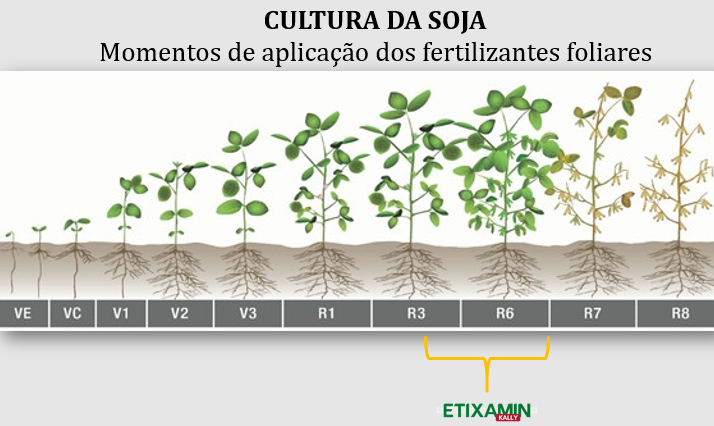
Figure 1. Foliar application of potassium in soybean cultivation. Source: ILSA Brazil
Potassium acts as an enzyme activator, participating in essential metabolic processes during grain filling. It contributes to the synthesis of proteins, starch, and lipids, fundamental components of soybean grains.
References:
BENITES, V. de M. et al. Potassium, calcium and magnesium. In: PROCHNOW, LI; CASARIN, V.; STIPP, SR (Eds.). Good practices for efficient use of fertilizers: nutrients. Piracicaba, SP: IPNI, Chapter 3, p. 137-191. 2010.
BORKERT, CM. Potassium in soybean cultivation. In: YAMADA, T.; ROBERTS, TL. Potassium in Brazilian agriculture. Piracicaba: Potafos, p. 671-713, 2005.
COUTINHO, Pablo Wenderson Ribeiro et al. Phosphorus doses in cowpea cultivation in the northeastern region of the State of Pará. Agro@mbiente Online Magazine, v. 8, n. 1, p. 66-73, 2014.
FERREIRA, Eric Victor de Oliveira et al. Potassium cycling and balance and soybean productivity in crop-livestock integration under no-till farming. Brazilian Journal of Soil Science, v. 35, p. 161-169, 2011.
FOLONI, J. S. S.; ROSOLEM, CA. Productivity and potassium accumulation in soybeans as a function of the anticipation of potassium fertilization in the no-till system. Brazilian Journal of Soil Science, v. 32, p. 1549-1561, 2008.
FRARE, TT Performance of soybean cultivars (Glycine max) treated with fungicide alone and in combination with insecticide and fertilizer. 2020. 24 p. Undergraduate Thesis (Agronomy) – Federal University of Uberlândia, Uberlândia, MG. 2020.
LEAL, Aguinaldo José Freitas et al. Soybean productivity according to different doses of potassium chloride coated or not with polymers. Global Science and Technology, v. 8, n. 1, p. 19-30, 2015.
LOPES, AS. Potassium mineral reserves and potassium fertilizer production in Brazil. In: YAMADA, T., & ROBERTS, TL. Eds. Potassium in Brazilian agriculture. Piracicaba, Potafos, p. 21-32, 2005.
MALAVOLTA, E. Manual of plant mineral nutrition. São Paulo: Agronômica Ceres, 2006. 638 p.
MARTINS, ES et al., Agrominerals: silicate rocks as alternative mineral sources of potassium for agriculture. In: LUZ, AB; LINS, FAF, eds. Industrial Rocks and Minerals. CETEM – Mineral Technology Center. 2nd ed., p. 205 – 223, 2008.
OLIVEIRA, FA et al. Soil fertility and mineral nutrition of soybeans. 2008.
OLIVEIRA JUNIOR, Adilson et al. Potassium fertilization of soybeans: considerations in nutrient balance. Agronomic information, pp. 1-10, 2013.
PEREIRA, Rogério Machado et al. Comparison of soybean cultivars in Southwest Goiás in response to the application of different doses of Potassium Chloride. Brazilian Journal of Development, v. 7, n. 1, p. 4132-4144, 2021.PRADO, RM; Plant nutrition.São Paulo: UNESP, 2008.
RESENDE, Álvaro Vilela et al. Potassium supply and research on the use of "in natura" rocks in Brazilian agriculture. Space and Geography Magazine, pp. 19-42, 2006.
SEDIYAMA, T. Soybean productivity. Londrina: Mecenas. 2016. 309p.
SFREDO, Gedi Jorge. Soybeans in Brazil: liming, fertilization, and mineral nutrition.. Londrina: Embrapa Soja, 2008.
SILVA, Amilton Ferreira da; LAZARINI, Edson. Potassium doses and application times in soybean cultivation following cover crops. 2014.
SILVA, EL. Potassium fertilization in soybean cultivation in the Cerrado region of Maranhão. 2016. 31 p. Undergraduate Thesis (Agronomy) – Federal University of Maranhão, Chapadinha, 2016.
SOUZA, JMPF. Slow-release fertilizer reduces losses due to leaching. Campo & Negócios Magazine, Uberlândia, n. 75, p. 28-29, 2010.
TAGLIEBER, André et al. Application of different doses of potassium chloride in soybean cultivation. Brazilian Journal of Development, v. 8, no. 4, p. 26041-26059, 2022.
TRENKEL, ME Slow-and controlledrelease and stabilized fertilizers: An option for enhancing nutrient use efficiency in agriculture. Paris: International Fertilizer Industry Association, 2010. 163p.
VILELA, L.; SOUSA, DMG de. SILVA, JE da. Potassium fertilization. In: SOUSA, DMG; LOBATO, E., eds. Cerrado: soil correction and fertilization. 2nd ed. Brasília, DF: Embrapa Informação Tecnológica, 2004. p. 169-182.
VINHAL-FREITAS, Isabel Cristina et al. Germination and vigor of soybean seeds classified into different sizes. Technical Agriculture, Sand, v. 32, no. 1, p. 108-114, 2011.
ZAMBIAZZI, Everton Vinicius et al. Agronomic performance and sanitary quality of soybean seeds in response to potassium fertilization. Journal of Agricultural Sciences, v. 40, no. 3, p. 543-553, 2017.
Authors:
Agr Eng. Dr. Angélica Schmitz Heinzen
Agricultural Eng. Msc. Thiago Stella de Freitas
Agricultural Engineer Tuíra Barcellos