

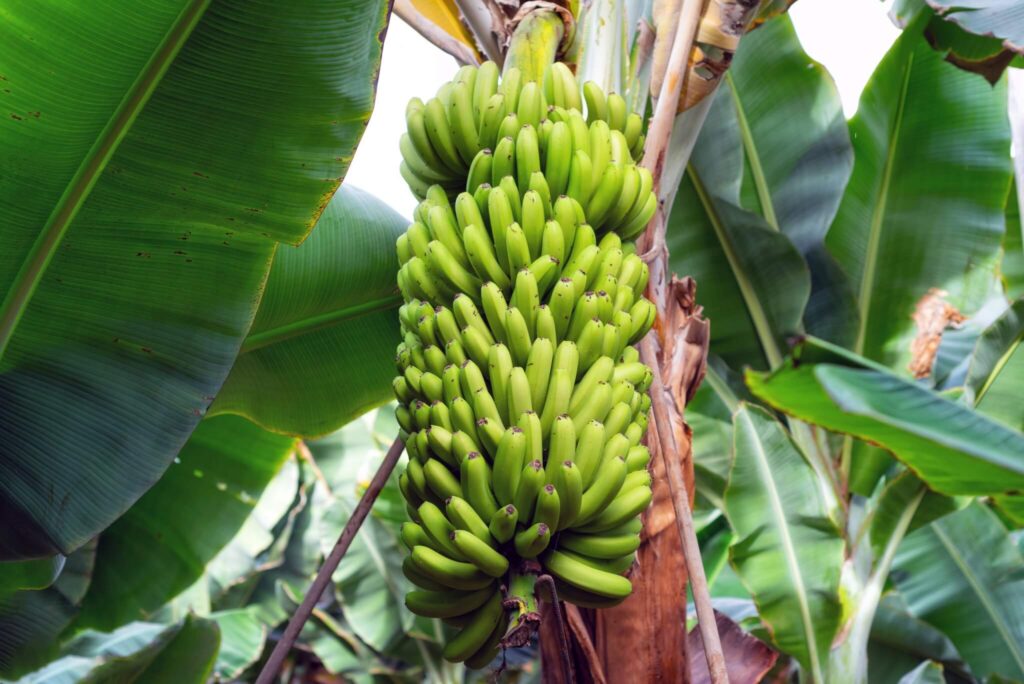
Banana is a nutrient-demanding crop due to its high production potential, which can reach 50 to 70 t/ha/year. The nutrients removed from the soil by the crop and exported during harvests need to be replaced frequently to avoid a decline in production, productivity and fruit quality (FEITOSA; LEITE JÚNIOR; PINTO, 2024).
From a physiological and nutritional point of view, potassium is extremely important for the plant, being responsible for the main metabolic reactions. It is estimated that for each ton of banana produced per hectare, the plant removes approximately 17 to 20 kg of potassium from the soil (SEBIM, 2023). In addition to activating more than 60 enzymes, this nutrient is an important regulator of the opening and closing of stomata, promoting photosynthesis, which also improves the efficiency of N use (BHALERÃO; DESHPANDE; BANSAL, 2018).
Nitrogen plays important roles in plants. In the photosynthetic apparatus, for example, it acts in the formation of the chlorophyll molecule, also participating in the processes of ionic absorption, respiration, multiplication and cell differentiation, being an important constituent of amino acids, proteins, nitrogenous bases and nucleic acids, and also of great importance for the vegetative development of plants until the beginning of the reproductive period (SILVA; PEREIRA; RODRIGUES, 2012). Because it is a nutrient with great mobility in the plant, the main symptoms of deficiency of this nutrient are: yellowing of old leaves, followed by a reduction in their size and useful life, thinner and more compressed pseudostem, aged leaf sheaths and reduction in the distance between one leaf and the next (FERREIRA; ANDRADE NETO, 2017).
Phosphorus is a macronutrient required in smaller quantities by the banana plant, but considered essential because it plays important roles in energy metabolism, such as the formation of ATP (Adenosine Triphosphate), and because it is an integral part of crucial compounds in plant cells, such as phosphate sugars, which are intermediate compounds in respiration and photosynthesis, as well as the phospholipids that make up plant membranes (TAIZ et al., 2017).
Banana tree cultivation requires large amounts of nutrients to maintain good plant development and production, with potassium and nitrogen being the most required. In decreasing order, the banana tree absorbs the following nutrients:
- macronutrients – potassium (K) > nitrogen (N) > calcium (Ca) > magnesium (Mg) > sulfur (S) > phosphorus (P); and
- micronutrients – chlorine (CI) > manganese (Mn) > iron (Fe) > zinc (Zn) > boron (B) > copper (Cu).
On average, a banana plantation removes, per ton of fruit, 5.2 kg of K; 1.9 kg of N; 0.30 kg of Mg; 0.23 kg of P and 0.22 kg of Ca (BORGES DA SILVA JUNIOR, 2010).
Nitrogen fertilization
NO is a very important nutrient for the vegetative growth of the plant, with a recommended application of 150 kg to 270 kg of N/ha/year, depending on the soil analysis and expected productivity. The first application should be done as a top dressing, around 30 to 45 days after planting (BORGES DA SILVA JUNIOR, 2010). In already formed banana plantations, it is recommended to apply 3 to 5 kg/ha/year of N per estimated ton of fruit to be harvested and it is suggested that fertilizers with N be divided into 4 to 5 times (ROLAS, 2016).
Phosphorus fertilization
Banana plants need small amounts of P, but if it is not applied, root development is impaired and, consequently, production is affected. The total amount recommended after soil analysis (40 to 120 kg of phosphorus/ha) should be applied at planting. Annually, after a new chemical analysis of the soil, phosphate fertilization can be repeated. Soils with P levels above 30 mg/dm3 (Mehlich extractor) do not require phosphate fertilization. Both P and organic fertilization will stimulate the development of the roots of banana seedlings (BORGES DA SILVA JUNIOR, 2010).
Potassium fertilization
K is considered the most important nutrient for the production of superior quality fruits. The recommended amount ranges from 100 to 750 kg of K20/ha, depending on the soil content and expected productivity. The first application should be done as a top dressing, in the 3rd or 4th month after planting. If the soil K content is less than 59 mg/dm3, the first application should be made at planting together with phosphate and organic fertilization. Soils with K levels above 234 mg/dm3 do not require potassium fertilization (BORGES DA SILVA JUNIOR, 2010) in the formation of the banana plantation. Annual fertilization is recommended.
Micronutrient fertilization
B and Zn are the micronutrients that most frequently cause deficiency in banana plants. For B levels in the soil below 0.21 mg/dm3 (hot water extractor), 2 kg of B/ha should be applied, and for Zn levels below 0.60 mg/dm3 (Mehlich extractor 1), 10 kg of Zn/ha. Fertilizers should contain the minimum possible amount of heavy metals, taking into account the damage they cause to the environment (BORGES DA SILVA JUNIOR, 2010).
Organic fertilization
It is the best way to provide N during the planting phase, especially when conventional seedlings are used, since losses are minimal and, in addition, it stimulates root development. After the banana plantation is established, covering the soil with the banana tree's own biomass (leaves and pseudostems) is one of the main alternatives available for banana growers to promote the addition and recycling of organic matter in the production system of this crop. This practice contributes to the increase in nutrient levels, especially N, P, K, Ca and Mg, and to significant improvements in the physical and biological attributes of the soil (BORGES DA SILVA JUNIOR, 2010).
Banana biomass
The use of crop residues or banana biomass to form mulch on the soil in banana plantations is equivalent to the application of a large quantity of organic matter. This is a recommended practice in the conventional system, but essential in the organic production system. This is because approximately two thirds of the mass produced by the banana plant is returned to the soil through defoliation, cutting of the pseudostem and leaves cut during harvesting. Dry matter production can reach 10 to 15 t/ha/year (BORGES DA SILVA JUNIOR, 2010).
The soil should be covered with a layer of banana biomass 5 to 10 cm thick, across the entire area. Since the organic material from the banana tree decomposes very quickly, as soon as the cover is thinned, more plant biomass should be added to prevent the soil from becoming exposed and water from being lost through evaporation. The ideal is to maintain the cover over the entire area or between the rows. If there is not enough material available, the plant biomass should be concentrated in alternating rows (BORGES DA SILVA JUNIOR, 2010).
ILSA offers a range of products for crop efficiency. For banana crops, we can highlight S-TIME, which has AZOGEL® as its matrix combined with elemental sulfur and can be added as a substitute for manure. It is recommended for areas with sulfur deficiency and should be incorporated (not placed in the planting hole). It can be applied and spread on the projection of the canopy at a distance of one hand's width from the trunk. Because it has a pelletized powder formulation, the fertilizer mineralizes faster and can release its nutrients for up to 90 days, depending on the weather conditions. In addition, it should be applied at two times: 1st before winter (0.5 kg/plant); 2nd at the beginning of spring (0.5 kg/plant).
It is worth remembering that the use and monitoring of soil analysis ensures that nutritional values can be maintained in balance and, based on this data, ILSA can have the specific product that will help maintain the nutritional value of the soil and the plant, in addition to increasing production. In this sense, ILSA also has a range of different formulations to adapt to the needs of each soil and banana plantation, see the example of producer Aureo José de Oliveira, who has been using Gradual Mix on his property for three years and shares the benefits he has seen over this period.
THE Gradual Mix comprises the line of organominerals with NPK fertilizers, and has in its formulation 16 essential amino acids for plant development. These fertilizers promote greater efficiency in the use of potassium and other cations due to the increase in CTC and the presence of organic carbon, which enhances microbial activity and contributes to improving soil health.
Another very interesting fertilizer for banana crops that has shown excellent results is Fertil. This product, based on hydrolyzed proteins (a natural source of amino acids), has a high content of organic N, organic carbon and high CEC. The action of the fertilizer is slow and mediated by soil microorganisms, thus promoting greater efficiency and balanced plant growth, in addition to improving soil health.
References:
BHALERAO, VP; DESHPANDE, AN; BANSAL, SK Potassium Dynamics in Inceptisols as Influenced by Graded Levels of Potash for Banana: I. Potassium Fractions. Communications in Soil Science and Plant Analysis, New York, v. 49, no. 15, p. 1886-1895, June, 2018.
BORGES, Ana Lúcia; DA SILVA JUNIOR, Josué Francisco. Nutrition, liming and fertilization. 2010.
FERREIRA, RRM; ANDRADE NETO, R. of C. Mineral nutrition and fertilization of banana plants. In: NOGUEIRA, SR; ANDRADE NETO, R. of C.; NASCIMENTO, GC do; GONZAGA, DS de OM Banana production system for the State of Acre. Rio Branco: Embrapa Acre, p. 41-51. (Embrapa Acre. Production System, 7). 2017.
FEITOSA FILHO, JC; LEITE JÚNIOR, GP; PINTO, JM Study indicates the possibility of reducing nitrogen and potassium doses if applied via fertigation compared to the same doses recommended for conventional fertilization in banana cultivation. 2024.
ROLAS – Official Network of Soil and Plant Tissue Analysis Laboratories. Liming and fertilization manual for the states of Rio Grande do Sul and Santa Catarina. Brazilian Society of Soil Science – Southern Regional Center: Soil Chemistry and Fertility Commission – RS/SC, 2016. 375p.
SEBIM, João Paulo Marim. NPK fertilization in triploid and tetraploid banana cultivars. 2023.
SILVA, JTA da; PEREIRA, RD; RODRIGUES, MGV Fertilization of 'Prata Anã' banana with different doses and sources of nitrogen. Brazilian Journal of Agricultural and Environmental Engineering, Campina Grande, v. 16, n. 12, p. 1314-1320, Aug. 2012.
TAIZ, L.; ZEIGER, E.; MOLLER, IM; MURPHY, A. Plant Physiology and Development. 6. ed. Porto Alegre: Artmed, 888 p. 2017.
Authors
Agr Eng. Dr. Angélica Schmitz Heinzen
Agricultural Eng. Msc. Thiago Stella de Freitas
Agricultural Engineer Tuíra Barcellos