


Plant development depends on the availability of mineral nutrients, which play a fundamental role in plant metabolic functions (Taiz et al., 2017). Both deficiency and excess of an element can cause alterations in the plant's life cycle, compromising its growth and productivity. Soil fertility is related to its capacity to supply these nutrients in adequate quantities and in forms that can be assimilated by plants. It is from the soil solution that plants absorb most of the essential elements to complete their cycle. Thus, understanding the interactions between soil and nutrients is fundamental to ensuring the efficient use of fertilizer, one of the practices that most impacts the cost of crop production today.
Soil is composed of mineral particles (such as clay and sand), organic matter, water, and air. The soil's ability to retain cations (positive charges) is called cation exchange capacity (CEC) and helps prevent nutrients from being washed away by rainwater or irrigation water in the leaching process. However, it can also make these nutrients unavailable to plants. Nutrients that are in the form of anions (negative charges), such as nitrate (NO₃⁻), phosphate (H₂PO₄⁻), and sulfate (SO₄²⁻), are not strongly retained by the soil's negative charges, making them more susceptible to losses. Soil texture influences nutrient retention and availability. Clay soils, with a larger specific surface area and charge, retain more cations and have a higher CEC, while sandy soils are more susceptible to leaching and require more careful fertilization management.
In this context, organic matter plays a strategic role by forming stable complexes with nutrients, reducing losses and providing a more gradual release of elements, which favors efficient use. In addition to this interaction with soil charges, ions interact with each other in the soil solution, and can favor or inhibit the absorption of nutrients by plant roots, depending on the combination of ions present (Table 1).
Table 1. How one ion can interfere with the absorption of another by plants. Adapted from Malavolta et al., 1989.
| Ion | Second ion present | Effect of the second on the first |
| Mg²⁺, Ca²⁺ | K⁺ | Competitive inhibition |
| H₂PO₄⁻ | Al³⁺ | Non-competitive inhibition |
| K⁺, Ca²⁺ | Al³⁺ | Competitive inhibition |
| H₂BO₃⁻ | NO₃⁻, NH₄⁺ | Non-competitive inhibition |
| K⁺ | Ca²⁺ (high concentration) | Competitive inhibition |
| SO₄²⁻ | SeO₄²⁻ | Competitive inhibition |
| SO₄²⁻ | Cl⁻ | Competitive inhibition |
| MoO₄²⁻ | SO₄²⁻ | Competitive inhibition |
| Zn²⁺ | Mg²⁺ | Competitive inhibition |
| Zn²⁺ | Ca²⁺ | Competitive inhibition |
| Zn²⁺ | H₂BO₃⁻ | Non-competitive inhibition |
| Fe²⁺ | Mn²⁺ | Competitive inhibition |
| Zn²⁺ | H₂PO₄⁻ | Competitive inhibition |
| K⁺ | Ca²⁺ (low concentration) | Synergism |
| MoO₄²⁻ | H₂PO₄⁻ | Synergism |
| Cu²⁺ | MoO₄²⁻ | Non-competitive inhibition |
Understanding these interactions helps to better plan fertilization, choosing sources and application methods that favor the availability and absorption of nutrients by the roots. The solutions offered by ILSA, being composed of organic N and amino acids from AZOGEL® (hydrolyzed protein of animal origin), help mitigate mineral nutrient losses due to the protective action of high CEC organic matter.
In addition to ion charges, a number of other soil and plant factors influence the absorption of nutrients from the soil solution (Faquin, 2005). Among these, soil pH stands out. A study conducted in southern Brazil with soybean crops indicated that soil acidity throughout the profile and low nutrient availability below 20 cm depth limited root growth in half of the evaluated crops (Mulazzani et al., 2024). This shows the importance of improving soil chemical conditions in deeper layers.
Studies conducted in southern Brazil show that the productivity loss for every 0.1 drop in pH below 5.5 in soybeans is 151 kg/ha.-1 (Winck et al., 2023) and in corn it is 560 kg ha-1 (Pilecco et al., 2024) (Figure 1). Furthermore, what is striking is the number of soybean (yellow circles) and corn (gray circles) crops with pH below the optimal pH range for good availability of most macro and micronutrients in the soil and reduction of toxic elements such as aluminum (Al), which is at pH 6.0 to 6.5 (Malavolta, 1979; Faquin, 2005). In general, Brazilian soils are clayey, acidic, with moderate to low levels of sulfur (S), calcium (Ca), and magnesium (Mg) (Pavinato et al., 2024), which highlights the importance of liming for plant nutrition. In addition to liming, the choice of fertilizers also directly influences soil pH, especially those containing nitrogen, due to the high doses that are generally used because it is the most required nutrient by plants in general.
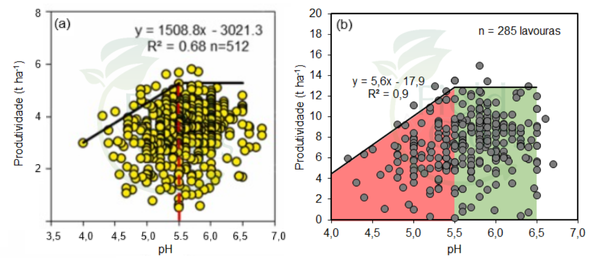
Figure 1. Relationship between soil pH and soybean productivity (a) and soil pH and corn productivity (b) in crops in Southern Brazil. Adapted from: Winck et al. (2023) and Pilecco et al. (2024).
Fertilizers that supply nitrogen in the form of ammonium, such as urea, tend to acidify the soil over time, mainly due to the release of hydrogen ions (H⁺) during absorption by plants. Nitrate, on the other hand, has a less acidifying effect and can even contribute to maintaining a more stable pH. In this context, organomineral fertilizers, such as ILSA's Gradual MIX line, which combines a high content of organic N and amino acids from AZOGEL® with mineral nutrient sources, stand out for promoting a more gradual release of nutrients, contributing to the chemical balance of the soil. When formulated with an appropriate ratio between NH4+ and NO3–, Organomineral fertilizers can help reduce negative effects on pH, improve nutrient use efficiency, and promote soil health.
In addition to chemical and physical interactions, biological interactions in the soil play a crucial role in nutrient dynamics. ILSA products, derived from AZOGEL®, are rich in organic carbon, which serves as an energy source for soil microorganisms. These microorganisms are essential for the decomposition of organic matter, for nutrient cycling, and for nitrogen fixation, contributing to soil health and biodiversity.
An example of the interaction between soil and nutrients is phosphorus. According to Pavinato et al. (2020), over more than 50 years of intensive agriculture, Brazilian soils have accumulated large quantities of phosphorus from phosphate fertilization. The authors estimate that more than 70% of the applied phosphorus remains in the soil in forms that are not readily available to plants, forming "legacy P". Management practices that favor the utilization of this P by crops include raising soil pH through liming, crop rotation, use of cover crops in the off-season, adoption of no-till farming systems, application of modern fertilizers, use of more efficient cultivars, and inoculation with phosphorus-solubilizing microorganisms (Pavinato et al., 2020).
Understanding the interactions between soil, nutrients, and plants is essential for promoting more efficient fertility management, reducing losses, and increasing the sustainability of agricultural production. By considering factors such as cation exchange capacity (CEC), pH, interionic effects, and the type of fertilizer used, it is possible to formulate more assertive fertilization strategies, adapted to soil conditions and crop needs. The adoption of technologies that integrate organic and mineral sources, combined with constant monitoring of soil chemistry, contributes not only to increased productivity but also to the construction of more resilient and balanced agricultural systems. ILSA's solid products, produced with AZOGEL, which guarantees 180 cmol of CEC, result in less potassium loss through leaching, increasing its uptake by plants. The organic matrix generates compounds that bind to Al and Fe, making more phosphorus available to plants, and its composition includes 16 amino acids, known as complexing agents, meaning they complex nutrients in the soil, making them available for absorption.
Bibliographic references
CAMPBELL et al. Agriculture production as a major driver of the Earth system exceeding planetary boundaries. Ecology and Society, vol. 22, no. 4, 2017.
FAQUIN V. Plant Mineral Nutrition. Federal University of Lavras, Lavras, 2005.
MALAVOLTA, E. ABC of Fertilization. 4th ed. São Paulo, SP: Agronômica Ceres, 1979. 255 p.
MALAVOLTA, E. et al. Evaluation of the nutritional status of plants: principles and applications. Piracicaba: Brazilian Association for Potash and Phosphate Research (Potafos), 1989. 201 p.
MULAZZANI, RP et al. Chemical constraints are the major limiting factor of root deepening in southern Brazil soils. Regional Geoderma, v. 38, p. e00825–e00825, 2024.
PAVINATO, PS et al. Revealing soil legacy phosphorus to promote sustainable agriculture in Brazil. Scientific Reports, v. 10, n. 1, 2020.
PAVINATO, PS et al. Legacy soil phosphorus bioavailability in tropical and temperate soils: implications for sustainable crop production. Soil and Tillage Research, v. 244, p. 106228–106228, 2024.
PILECCO et al. Ecophysiology of maize aiming at high yields. GR Publisher, Santa Maria, 2024. 400p.
TAIZ, L. et al. Plant physiology and development. 6th ed. Porto Alegre: Artmed, 2017. 888 p. ISBN 978-85-8271-366-2.
WINCK et al. Decomposition of yield gap of soybean in environment × genetics × management in Southern Brazil. European Journal of Agronomy, vol. 145, p. 126795–126795, 2023.
Authors
Agr Eng. MSc. Isabela Bulegon Pilecco
Agricultural Eng. Msc. Thiago Stella de Freitas
Agricultural Engineer Tuíra Barcellos