

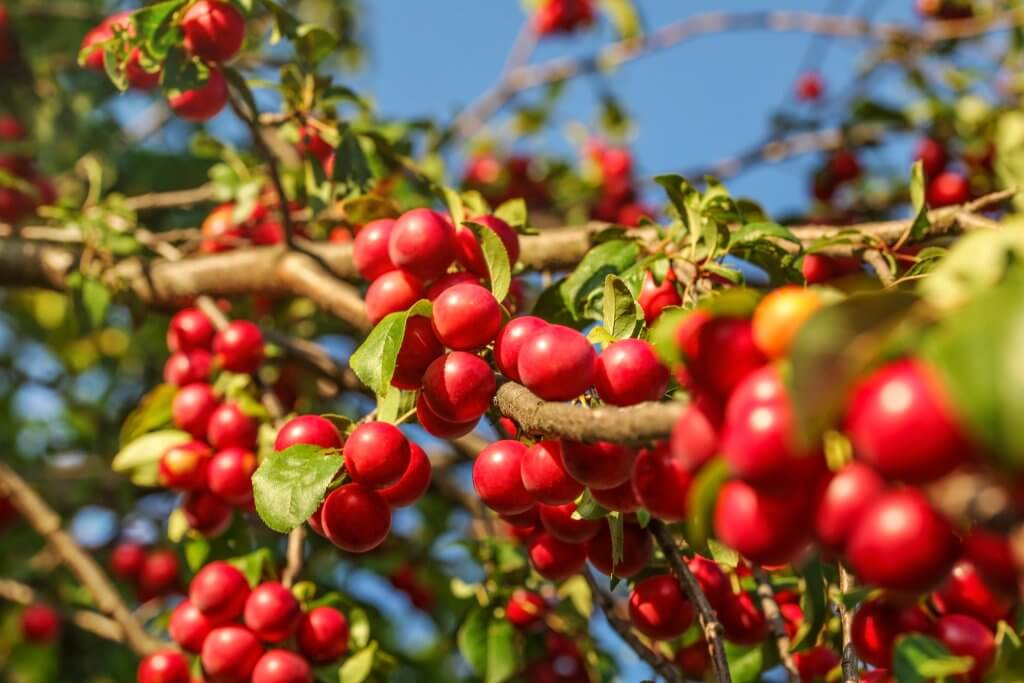
Stone fruits include peaches, plums, nectarines, cherries and apricots, which belong to the drupaceae group. These plants adapt very well to areas with cold winters and hot, dry summers, preferring deep, well-drained soils, rich in organic matter and with a neutral, slightly acidic pH. Regarding nutrition, drupaceae are extremely demanding in terms of nitrogen and potassium, but respond very well to the application of micronutrients. Micronutrients are, in short, minerals that plants need in smaller quantities when compared to macronutrients, but this does not mean that they are less important. In crops in general, among micronutrients, B deficiency is the most frequent (Gupta, 1979; Blevins & Lukaszewski, 1998) and, therefore, its lack can lead to serious problems in orchards.
How does boron act on plants?
Boron (B) is considered an essential micronutrient for the good development of plants in general. According to Shorrocks (1997), B is found in soil in five forms: primary minerals such as tourmaline and micas rich in B; secondary minerals, mainly within the structure of clays; adsorbed to clays, on the surface of hydroxides and in organic matter; in solution as boric acid (H3BO3) and as borate (or borax, with chemical formula Na2B4THE7); as well as in organic matter and microbial biomass. The absorption of B by the roots occurs mainly in the form of boric acid – the most soluble form, and is influenced by several environmental factors, such as pH, soil texture, humidity, temperature, organic matter, light intensity and clay mineralogy (Hu & Brown, 1997). Once absorbed by the roots, boron is transported throughout the plant predominantly through the xylem vessels, due to the plant's transpiration flow.
Boron is directly involved in the process of cell development and elongation and in the structural integrity of the cell wall, and is often associated with pectins, as suggested by Hu et al. (1997). Another important function of boron is the maintenance of the integrity of plasma membranes and their ability to bind to glycoproteins and glycolipids – important membrane builders. In addition, Power and Woods (1997) state that the transport of some nutrients across the membrane, mainly potassium and phosphorus, is inhibited in the absence of B. Furthermore, B is also related to sugar transport, lignification, carbohydrate metabolism, RNA metabolism, respiration, indole-acetic acid (IAA) metabolism and ascorbate phenol metabolism (Cakmak & Römheld, 1997).
In addition, boron also participates in two other very important processes: pollen grain germination and pollen tube formation and growth. Malavolta (2006) also states that B increases flower set in several crops and ensures reduced male sterility. It also has a positive effect on root growth, due to its participation in cell division and expansion processes.
Symptoms of Boron Deficiency in Stone Fruits
Boron is one of the micronutrients that most limits crop yield in Brazil, especially in crops grown in sandy soils, where the micronutrient, which has high mobility in the soil, can be leached into the profile (Blevins & Lukaszenwski, 1998). According to Goldberg (1997), the main factors that determine the availability of boron to plants are: 1. soil texture, the sandier the soil, the lower the availability of the nutrient; 2. soil moisture, with the availability of B generally decreasing with reduced soil moisture; 3. temperature, which when it increases causes greater adsorption of B, however, this may be due to the interaction between the effect of temperature and soil moisture; 4. organic matter, where the greater the amount of organic matter, the greater the availability of B for plants.
B absorption occurs through diffusion and mass flow, i.e., a lack of water can limit its contact with the root surface and consequently reduce absorption. As for the root system, a deficiency of this nutrient inhibits full development – this is one of the most obvious symptoms, hindering the plant's ability to penetrate deeper layers in search of water and nutrients (Shelp, 1993; Trautmann, 2014), in addition to inhibiting or stopping the elongation of primary and secondary roots, which become short and branched (Marschner, 1986). In leaves, since it is an element with low mobility, its deficiency is first observed in new branches and in the plant's apical meristems, compromising the entire development of the orchard in the long term.
Regarding the flowering season, as already mentioned, B actively participates in the formation of the pollen tube and germination, as well as in the setting of flowers. The flowering of stone fruits generally occurs in periods of high humidity and low temperature, factors that can cause premature flower drop. In B deficiency, this drop is even more evident, which can cause the flower to deteriorate even before fertilization. Since boron is part of the transport process of some nutrients and sugars, its deficiency can cause a reduction in the consistency of the fruit pulp, compromising transport and subsequent post-harvest storage, as cited by Roveda et al. (2006).
ILSAMIN Boro® – Exclusive ILSA Brasil technology
Boron deficiency causes biochemical, physiological and anatomical changes, some of which have secondary effects (Souza, 2011). Due to the rapidity and wide variety of symptoms that occur after boron suppression in crops, adequate supply of this micronutrient is essential. ILSA Brasil has the liquid organomineral fertilizer ILSAMIN Boro®, for foliar application, produced from proteins hydrolyzed by enzymes (GELAMIN®), which represent a natural source of rapidly absorbed amino acids, making their nutritional elements available to plants and balancing nutrition in the most critical phases. According to Volkweiss (1991), foliar application allows for the correction of deficiencies in the short term, especially in the flowering phase, with faster responses and numerous advantages, such as more uniform distribution per unit area, reduced dose and greater ease of application.
ILSAMIN Boro® contains 15 % of total carbon, 4 % of water-soluble nitrogen and 5 % of water-soluble boron, in addition to providing essential amino acids to plants. Due to its formulation, the use of this fertilizer stimulates tissue growth, especially in apical meristems – since B is directly associated with the process of cell growth and elongation. In addition, by actively participating in flowering, improving the development of the pollen tube and helping with flower set, ILSAMIN Boro® stimulates and promotes flower health, contributing to the formation of excellent quality fruits – since boron also acts in the transportation of carbohydrates and nutrients, generating an increase in productivity.
Like all ILSA Brasil fertilizers, ILSAMIN Boro® has a low environmental impact in all its production processes, contributing to a sustainable production system and supporting the environment.
Bibliographic references
BLEVINS, DG; LUKASZEWSKI, KM Boron plant structure and function. Annual Review of Plant Physiology and Plant Molecular Biology, Palo Alto, v.49, p.481-500, 1998.
CAKMAK, I.; RÖMHELD, V. Boron deficiency-induced impairments of cellular functions in plants. Plant and Soil, Dordrecht, v.193, n.1-2, p.71-83,1997.
GOLDBERG, S. Reactions of boron with soils. In: DELL, B.; BROWN, PH; BELL, RW Boron in soils and plants: Reviews. Dordrechet: Kluwer Academic, p.35-48, 1997.
GUPTA, UC Boron nutrition of crops. Advances in Agronomy, San Diego, v.31, p.273- 307, 1979.
HU, H.; BROWN, PH Absorption of boron by plant roots. Plant and Soil, Dordrecht, v.193, n.1/2, p.49-58, 1997.
HU, H.; PENN, SG; LEBRILLA, CB; BROWN, PH Isolation and characterization of soluble boron complexes in higher plants: the mechanism of phloem mobility of boron. Plant Physiology, Rockville, v.113, n.2, p.649-655, 1997.
MALAVOLTA, E. Manual of mineral nutrition of plants. São Paulo: Agronômica Ceres, 2006, 638 p.
MARSCHNER, H. Mineral nutrition of higher plants. London: Academic Press, 1986.
POWER, P.P; WOODS, WG The chemistry of boron and its speciation in plants. Plant and Soil, Dordrecht, v.193, n.1/2, p.1-14,1997.
ROVEDA, LF; BLOOD, RRY; MOTTA, ACV; SERRAT, BM Quality and productivity in peach trees and establishment of white clover as cover crop, influenced by boron application. Scientia Agraria, v. 7, n. 1-2, p. 75-82, 2006.
SHELP, BJ Physiology and biochemistry of boron in plants. In: GUPTA, UC, ed. Boron and its role in crop production. Boca Raton, CRC Press, p.53-85, 1993.
SHORROCKS, VM The occurrence and correction of boron deficiency. Plant and Soil, Dordrecht, v.193, n.1/2, p.121- 148, 1997.
SOUZA, JA Boron mobility (10B) in cashew tree (Anacardium occidentale L.) and peach tree (Prunus persica L.). São Paulo State University, Ilha Solteira, 2011. 69 p. (Master's Dissertation)
TRAUTMANN, RR et al. Soil water potential and boron fertilization on growth and nutrient uptake by soybean crops. Brazilian Journal of Soil Science, v. 38, n. 1, p. 240–251, 2014.
VOLKWEISS, SJ Sources and application methods. In: Symposium on micronutrients in agriculture, Jaboticabal. Proceedings, Potafós/CNPq. p.391-412, 1991.
Authors
- Agricultural Eng. Msc. Aline Tramontini dos Santos
- Agricultural Eng. Msc. Carolina Custodio Pinto
- Agricultural Eng. Msc. Thiago Stella de Freitas