



Before delving into the subject, let us understand what soil profile means. Soil is made up, in different proportions, of mineral particles of very different sizes and also of organic matter resulting from the transformation of vegetation residues that have been present since the beginning of the weathering of the rock. These mineral and organic fractions have very varied composition and properties and rarely occur in isolation, but rather interact with each other to form sets of particles called aggregates. The empty spaces between the elementary or aggregated particles constitute the so-called soil pores, which are filled with water and air in varying proportions and are as important for the functioning of the soil as their respective solid constituents (FONSECA, 2019).
The elements that characterize the soil result from the action of the so-called soil formation factors (climate, parent rock, vegetation and other organisms, including human beings, relief and time), whose relative influence on soil formation processes varies from place to place and determines the enormous variety of existing soils (FONSECA, 2019).
From a morphological point of view, soil formation processes generally result in the differentiation in depth of several layers with distinct characteristics, which are called horizons, which together constitute the soil profile. These horizons, which can be observed in a vertical section made in a soil (Figure 1), are layers that are roughly parallel to the surface of the ground, separated from each other by more or less evident boundaries, which are distinguished from each other by characteristics such as color, texture, structure (aggregation), consistency and density of the roots that occur in them (FONSECA, 2019).
Below the horizons, there is generally, at greater or lesser depths, material that has not yet weathered, which is the parent rock of the soil, that is, the rock from which the overlying horizons were differentiated. For a complete characterization of the different horizons and for their identification and designation, laboratory data are required. It is based on the identification and characterization of the horizons present in each profile that the soil is classified according to criteria defined in the various taxonomic systems used for this purpose (FONSECA, 2019).
Thus, the nomenclature of horizons (and sub-horizons) is not uniform and has varied over time. However, the most commonly used is called ABC nomenclature. In this system, A is the most superficial mineral horizon, generally enriched in organic matter, B is a sub-surface horizon resulting from the in-situ alteration of the original material, the accumulation of materials translocated from other horizons, or the residual accumulation of non-mobile or slightly mobile constituents, and C is the regolith (altered rock material). Among the main horizons and layers, we can also distinguish the E horizon, a horizon strongly depleted in clay or organic compounds, which were translocated to a B horizon, and the R layers, which designate the underlying consolidated rock (FONSECA, 2019).
Soil profile – Soil profile corresponds to a vertical section that starts at the soil surface and ends at the rock, and may be made up of one or more horizons (Figure 1).
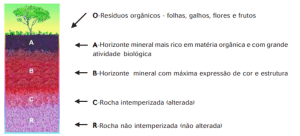
Figure 1. Schematic representation of the soil profile, showing its main horizons and layers (LIMA; MELO, 2007).
The construction of the soil profile is efficient when the practices used in the soil favor the growth of roots, making the absorption of water and nutrients as effective as possible (RICHART et al., 2005).
In new areas, there may be advantages when there is no heavy machinery movement or a high number of animals in the area, which reduces soil compaction and increases the space available for roots. Soil and crop management practices cause changes in the physical properties of the soil, which may be permanent or temporary (RICHART et al., 2005). Thus, interest in evaluating the physical quality of the soil has increased because it is considered a fundamental component in the maintenance and/or sustainability of agricultural production systems (LIMA, 2004).
According to Stenberg (1999) and Schoenholtz, Van Miegroet and Burger (2000), soil physical quality indicators should cover the physical, chemical and biological attributes of the soil; incorporate the variability of properties; be sensitive to long-term variations caused by seasonal changes; be accurately measurable across a wide variety of soil classes and conditions; be simple to measure; have a low cost and be adaptable to different systems. Singer and Ewing (2000) and Imhoff (2002) suggest the use of soil physical quality indicators that include physical attributes that directly influence crop production, such as the extent to which the soil matrix resists deformation; the soil's ability to provide adequate aeration and water for the growth and expansion of the root system.
According to Topp et al. (1997), Schoenholtz, Van Miegroet and Burger (2000) and Singer and Ewing (2000), the attributes most widely used as indicators of soil physical quality are those that take into account the effective rooting depth, total porosity and pore size and distribution, particle size distribution, soil density, soil resistance to root penetration, optimum water range, compression index and aggregate stability.
How the soil profile influences the microbiological composition of the soil:
The soil's function is to support life processes, that is, to provide physical support and nutrients for plants, promote water retention and movement, support food chains and environmental regulatory functions, including nutrient cycling, the diversity of macro and microorganisms, the remediation of pollutants and the immobilization of heavy metals (BEZDICEK, 1996).
Among the various justifications for the use of microorganisms and microbiological processes as indicators of soil quality, the most notable are their ability to respond quickly to changes in the soil environment resulting from changes in management and the fact that soil microbial activity reflects the joint influence of all factors that regulate the degradation of organic matter and the transformation of nutrients (KENNEDY; PAPENDICK, 1995; STENBERG, 1999).
Microorganisms also constitute a large and dynamic source and deposit of nutrients in all ecosystems and actively participate in beneficial processes such as soil structuring, biological N fixation, solubilization of nutrients for plants, reduction of pathogens and plant pests, degradation of persistent compounds applied to the soil, in mycorrhizal associations and in other soil properties that affect plant growth (KENNEDY; PAPENDICK, 1995; Kennedy; Smith, 1995). Thus, a high-quality soil has intense biological activity and contains balanced microbial populations, with several microbiological indicators that can provide an estimate of soil quality.
The soil profile is a limiting factor for root development and high productivity. Low root development makes the crop more susceptible to water deficits, reduces the amount of nutrients exploited in the soil and maximizes losses due to pathogen attacks.
Investing in the quality of soil profile construction means investing in high productivity, in addition to crop longevity. In this way, crops achieve good root development, which also contributes to the improvement of subsurface layers. We should always think of new areas as an opportunity to structurally improve the soil, and thus the return on its quality will be a pleasant consequence.
References:
BEZDICEK, DF Development and evaluation of indicators for agroecosystem health. Agriculture in Concert with the Environment ACE Research Projects Western Region, 1996. p.1991-1995.
FONSECA, Madalena. What is a soil profile? Elementary Science Journal, v. 7, n. 2, 2019.
KENNEDY, AC & PAPENDICK, RI Microbial characteristics of soil quality. J. Soil Water Conserv., 50:243-248, 1995.
KENNEDY, AC & SMITH, KL Soil microbial diversity and the sustainability of agricultural soils. Plant Soil, 170:75-86, 1995.
LIMA, Valmiqui Costa; MELO, Vander de Freitas. Soil profile and its horizons. Soil in the environment: an approach for elementary and high school teachers and high school students. Curitiba: Department of Soils and Agricultural Engineering, p. 11-16, 2007.
RICHART, Alfredo et al. Soil compaction: causes and effects. Semina: Agricultural Sciences, v. 26, n. 3, p. 321-343, 2005.
IMHOFF, SC Indicators of structural quality and trafficability of Latosols and Red Argisols. 2002. 104p. Thesis (Doctorate in Agronomy) – Department of Soils and Plant Nutrition, “Luiz de Queiroz” College of Agriculture, University of São Paulo, Piracicaba, SP.
LIMA, Cláudia Liane Rodrigues de. Soil compressibility versus traffic intensity in an orange orchard and animal trampling in irrigated pasture. 2004. Doctoral Thesis. University of São Paulo.
STENBERG, B. Monitoring soil quality of arable land: microbiological indicators. Soil and Plant Science, v.49, n.1, p.1-24, 1999.
SCHOENHOLTZ, SH; VAN MIEGROET, H.; BURGER, JA A review of chemical and physical properties as indicators of forest soil quality: challenges and opportunities. Forest Ecology and Management, Wageningen, v.138, p.335-356, 2000.
SINGER. M.; EWING, S. Soil quality. In: SUMNER, ME Handbook of soil science. Boca Raton: CRC Press, 2000. p.271-298.
STENBERG, B. Monitoring soil quality of arable land: microbiological indicators. Soil Plant Sci., 49:1-24, 1999.
TOPP, GC; REYNOLDS, W.D.; COOK, FJ; KIRBY, JM; CARTER, MR Physical attributes of soil quality. In: GREGORICH, EG; CARTER, MR Soil quality for crop production and ecosystem health. Amsterdam: Elsevier Science, 1997. p.21-58.
TÓTOLA, MR; CHAER, GM Microorganisms and microbiological processes as indicators of soil quality. Topics in soil science. Viçosa, MG, Brazilian Society of Soil Science, v. 2, p. 195-276, 2002.
Authors
Agr Eng. Dr. Angélica Schmitz Heinzen
Agricultural Eng. Msc. Thiago Stella de Freitas