


The main climatic stress factors for plants are high temperatures and drought, which affect growth, development, and induce morphological, physiological, and biochemical changes in plants (Fahad et al., 2017). This is because approximately 90% of the plant mass is composed of water, which acts in essential physiological and biochemical processes (Taiz et al., 2017). Plants require adequate amounts and distribution of water throughout their development cycle. Figure 1 is an example of a corn crop in the 2021/2022 growing season in the municipality of São Vicente do Sul/RS. This crop was influenced by the El Niño Southern Oscillation phenomenon in the La Niña phase, which in Rio Grande do Sul causes a reduction in rainfall during the corn growing months (Noia Junior; Sentelhas, 2020).

Figure 1. Corn cob after water deficit in the municipality of São Vicente do Sul/RS, in the 2021/2022 crop season.
Such situations occur when the water supply is less than the plant's water demand, especially during critical phases. In general, the initial stages of plant development are sensitive to water deficit or excess in the soil, affecting crop productivity, since one of the main components of productivity, the number of plants per area, is being defined at this stage. Water deficit during flowering and grain filling also leads to significant losses in most grain crops, because productivity components such as the number of grains (dependent on pollination) and grain weight are being defined during these phases. In addition to productivity losses, water deficit can reduce the quality of agricultural products. Table 1 presents the water demand during the development cycle and the critical stages for water deficit in some crops.
Table 1. Water demand during the development cycle and stage of highest demand.
| Culture | Approximate water demand (mm/cycle) | Season of highest water demand | Source |
| Coffee | 1200 | Flowering and small fruit | Carvalho et al. (2013); Gomes et al. (2007) |
| Soy | 450 to 875 | Flowering and grain filling | Carvalho et al. (2013); Silva (2018); Tagliapietra et al. (2022) |
| Corn | 400 to 700 | Flowering | Albuquerque; Resende (2007) |
| Citrus | 600 to 1200 | Flowering and fruit formation | Magalhães et al. (2005) |
| Cane | 1000 to 2000 | Vegetative growth | Carvalho et al. (2013); Abreu et al. (2013) |
Several strategies can be adopted to avoid water deficit, including the use of supplemental irrigation, the choice of crop sowing time, and the choice of cultivar or hybrid. For example, Tagliapietra et al. (2022) identified that the water demand throughout the soybean development cycle in Southern Brazil varies according to the Relative Maturity Group (RMG), requiring 730 mm, 850 mm, and 875 mm, respectively, for cultivars with RMG ≤ 5.5, RMG 5.6 to 6.4, and RMG ≥ 6.4 to complete their development cycle and produce 100 sc/ha. In other words, shorter-cycle cultivars require less water to achieve the same productivity as longer-cycle cultivars. Another example is the soybean-corn system in the Midwest of Brazil, in which soybean sowing must be adjusted to the beginning of the rainy season, using short-cycle cultivars, so that corn can be grown within the window recommended by the agricultural zoning, avoiding water deficit (Pilecco et al., 2024).
However, these strategies are defined before the start of the crop season. After sowing, plant nutrition plays a fundamental role in mitigating the impacts of water deficit. Adequate nutrient availability improves plant adaptation to adverse conditions, reducing the negative effects of water stress on productivity (Waraich et al., 2011). Globally, the combination of problems related to low soil fertility and environmental stresses is the main cause of losses in agricultural production (Cakmak, 2005). Thus, caring for soil health and plant nutrition is fundamental for crop stability and productivity, mitigating the effects of biotic and abiotic stresses, such as water deficit.
The reduction in productivity caused by water deficit can occur due to the closure of the plant's stomata, aiming to reduce water loss through transpiration (Taiz et al., 2017). With the closure of the stomata, CO2 assimilation is reduced.2 Atmospheric water is reduced, causing a decrease in photosynthetic rates and, consequently, in biomass production. Furthermore, in situations of high stress, there is an overproduction of reactive oxygen species (ROS). The accumulation of these reactive species damages cellular components, potentially leading to programmed cell death (Taiz et al., 2017). To degrade ROS, the plant uses enzymatic and non-enzymatic antioxidants, which has a high energy cost, compromising plant growth and productivity. However, with reduced transpiration, nutrient absorption from the soil is also limited. Therefore, ensuring an adequate supply of nutrients from the beginning of the cycle is essential. Given these challenges, let's explore the role of the main macronutrients, micronutrients, and amino acids in mitigating the effects of water deficit in plants.
Nitrogen (N) is absorbed by plants primarily as nitrate and ammonium, with nitrate being the most available form in the soil. Within the plant, nitrate is converted to nitrite and incorporated into organic compounds, a process mediated by the enzyme nitrate reductase (Taiz et al., 2017). Under water deficit conditions, the activity of this enzyme is reduced (Azedo-Silva et al., 2004), but N supplementation can increase its activity and nitrate absorption. Furthermore, applying N when there is good availability of solar radiation strengthens the plant's antioxidant mechanisms.
Phosphorus (P) plays a fundamental role in root growth and in regulating leaf water potential, aiding in the maintenance of cell turgor and stomatal opening (Taiz et al., 2017). This effect contributes to the efficiency of photosynthesis, even under water deficit conditions. Potassium (K) helps reduce the production of reactive oxygen species (Hasanuzzaman et al., 2020) and improves photosynthesis under water stress conditions (Raza et al., 2014). Furthermore, it promotes root development by increasing the surface area for water absorption (Romheld; Kirkby, 2010).
Calcium (Ca) plays an important role in the recovery of plants subjected to water stress, contributing to the stability of cell membranes and acting as a messenger in stress signaling (Taiz et al., 2017). Furthermore, it assists in the activation of plasma membrane ATPase, which regulates ion transport and contributes to maintaining osmotic balance in damaged cells. Magnesium (Mg) stimulates root growth, increasing water and nutrient absorption (Hansel et al., 2021). It also improves the transport of sugars from leaves to roots and reduces damage caused by light oxidation in chloroplasts, thus maintaining the photosynthetic rate and productivity under stress (Waraich et al., 2011). In addition, it increases the activity of enzymes and antioxidant molecules, decreasing ROS levels (Waraich et al., 2011). Sulfur (S) contributes to the formation of cysteine, an amino acid important for the detoxification of ROS (Hansel et al., 2021). Micronutrients such as iron (Fe), copper (Cu), manganese (Mn), and zinc (Zn) act as cofactors for antioxidant enzymes, essential in the elimination of ROS (Jaleel et al., 2009).
Amino acids are essential components or participate in the synthesis of enzymes, structural proteins, chlorophyll, and plant hormones, in addition to contributing to the transport and storage of nutrients in plant tissues. Therefore, they play a fundamental role in plant growth and development, as well as in their adaptation to biotic and abiotic stresses. Proline and glycine, highlighted in the amino acid profile of AZOGEL (Figure 2) and GELAMIN (Figure 3), organic matrices of ILSA products, also play an important role in mitigating the effects of water deficit, contributing to plant resilience under adverse conditions.
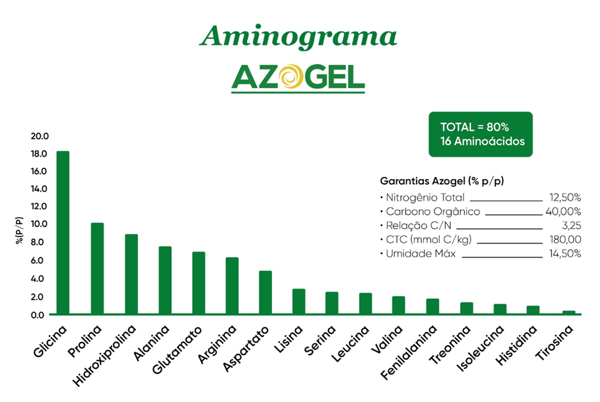
Figure 2. Aminogram of AZOGEL
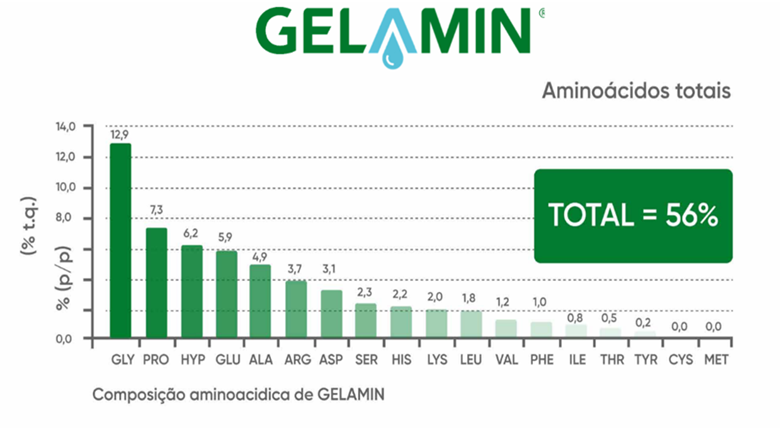
Figure 3. GELAMIN aminogram
During water stress, the plant uses proline and glycine betaine (a compound derived from glycine) to maintain osmotic balance, promoting the accumulation of solutes in the cytosol and vacuole of cells. In this way, water (the solvent) moves from the external environment (lower solute concentration) to the interior of the cell (higher solute concentration), preserving its hydration (Taiz et al., 2017). Proline and glycine betaine are classified as compatible solutes, meaning they can accumulate in high concentrations in the cytosol without inhibiting the activity of essential enzymes. In addition to its osmotic function, proline also acts as an osmoprotectant, protecting plants from the effects of ROS (Reactive Oxygen Species) and serving as a source of carbon and nitrogen during cell recovery, once environmental conditions normalize (Taiz et al., 2017). Glycine also acts in reducing oxidative stress, maintaining metabolism, and aiding plant recovery after water stress.
Faced with the challenges posed by water stress, balanced plant nutrition is a tool that helps reduce the negative effects of water deficit. Macronutrients and micronutrients play fundamental physiological roles in this process, such as osmotic regulation and enzymatic activation, ensuring better plant adaptation to adverse conditions. Technologies that combine mineral and organic sources of nutrients, in addition to being a balanced source of nutrients and amino acids, have a stimulating effect on root development and are beneficial to the soil, allowing plants to explore a larger area of soil in search of water and nutrients. Thus, they help mitigate the effects of water deficit and enable greater stability for crop productivity. ILSA offers a complete portfolio to strengthen crops throughout the entire production cycle. From seed treatment with ILSAMIN RADIX to nutritional support at different stages of cultivation with GRADUAL MIX (in solid form) and the liquid fertilizers ILSAMIN POTENTE and ILSAMIN FULL.
Bibliographic references
ABREU, ML et al. Growth and productivity of sugarcane as a function of water availability in the coastal plains of Alagoas. Bragantia, Campinas, v.72, n.3, p.262-270, 2013.
ALBUQUERQUE, PEP de; RESENDE, M. Irrigation: irrigation management. In: CRUZ, JC (Ed.). Corn cultivation. 3rd ed. Sete Lagoas: Embrapa Milho e Sorgo, 2007.
AZEDO-SILVA, JJ; OSORIO, FF; CORREIA, MJ Effects of soil drying and subsequent re-watering on the activity of nitrate reductase in roots and leaves of Helianthus annuus. Functional Plant Biology, vol. 31, p. 611-621, 2004.
CAKMAK, I. Role of mineral nutrients in tolerance of crop plants to environmental stress factors. In: Proceedings from the International Symposium on Fertigation – Optimizing the utilization of water and nutrients. Horgen: International Potash Institute, 2005. p. 35-48.
CARVALHO, RI et al. Water demand of crops of agronomic interest. Biosphere Encyclopedia, Conhecer Scientific Center – Goiânia, v.9, n.17; p. 2013.
FAHAD, S. et al. Crop production under drought and heat stress: Plant responses and management options. Frontiers in Plant Science, vol. 8, p. 1147, 2017.
GOMES, NM et al. Vegetative growth and productivity of irrigated coffee plants in the south of the State of Minas Gerais. Brazilian Journal of Agricultural and Environmental Engineering, v.11, p.564-570, 2007.
HANSEL, FD Mineral nutrition as an ally of plants in tolerance to environmental stresses. Agronomic Information, NPCT, no. 9, 2021.
HASANUZZAMAN, M. et al. Reactive oxygen species and antioxidant defense in plants under abiotic stress: revisiting the crucial role of a universal defense regulator. Antioxidants, vol. 9, p. 681, 2020.
JALEEL, CA et al. Antioxidant defense responses: physiological plasticity in higher plants under abiotic constraints. Acta Physiologiae Plantarum, v. 31, p. 427-436, 2009.
MAGALHÃES, AFJ et al. Production system for small citrus producers in the Northeast. Cruz das Almas: Embrapa Mandioca e Fruticultura Tropical, 2005. 178p. (Production system 17).
NOIA JUNIOR, RS; SENTELHAS, PC Yield gap of the double-crop system of main-season soybean with off-season maize in Brazil. Crop and Pasture Science, v.71, n. 5, p. 445-458, 2020.
PILECCO, IB et al. Ecophysiology of maize aiming at high yields. Santa Maria, Editora GR, 2024. 400p.
RAZA, MAS et al. Exogenous application of glycinebetaine and potassium for improving water relations and grain yield of wheat under drought. Journal of Soil Science and Plant Nutrition, vol. 14, p. 348-364, 2014.
ROMHELD, V.; KIRKBY, EA Research on potassium in agriculture: Needs and prospects. Plant and Soil, vol. 335, p. 155-180, 2010.
SILVA, RA. Impact of climate change on the productivity and water footprint of soybeans cultivated in the MATOPIBA region. Doctoral thesis in Meteorology, Center for Technology and Natural Resources, Campina Grande: UFCG, 2018.
TAGLIAPIETRA, EL et al. Ecophysiology of soybeans aiming at high yields. Santa Maria: Editora GR, 2022. 432 p.
TAIZ, L. et al. Plant physiology and development. 6th ed. Porto Alegre: Artmed, 2017. 888 p.
WARAICH, EA et al. Role of mineral nutrition in alleviation of drought stress in plants. Australian Journal of Crop Science, vol. 5, p. 764-777, 2011.
Authors:
Agr Eng. MSc. Isabela Bulegon Pilecco
Agricultural Eng. Msc. Thiago Stella de Freitas
Agricultural Engineer Tuíra Barcellos