


Potassium is the second most required macronutrient by plants and is absorbed mainly through the roots in its ionic form (K+Unlike nitrogen and phosphorus, this mineral is not a constituent of any organic molecule in the plant (making it highly mobile within the plant), although it is associated with several key functions in the plant.
The importance of potassium
It is responsible for controlling water entry into cells, increasing root growth, enhancing resistance to adverse conditions, and also promotes nitrogen absorption and protein synthesis, favoring the nodule formation process in legumes.
The lack of this mineral results in plants that are more susceptible to periods of stress, such as water deficit, pest and disease attacks, and sudden temperature fluctuations. In more extreme cases, other characteristic symptoms can be observed, such as lodging, growth inhibition, necrosis on leaf edges, and chlorotic areas that advance towards the center of the leaves. In grains, a deficiency of this nutrient causes deformation, reduced size, and wrinkling.
Brazilian soils, in most cases, have low potassium availability. It is crucial, however, to mention that a balanced supply of this nutrient is essential for successful crop growth. Tools such as foliar and soil analysis, as well as knowledge of the area's history, are crucial when deciding on the source and timing of application. Furthermore, the application site can also influence the outcome of fertilization.
What are the problems caused by excess potassium in your crops?
Potassium fertilizers, regardless of the production system, can be added to the soil in rows or broadcast, aiming for successful fertilization of the system where the soil has adequate levels of K (CASTOLDI et al., 2012).
In row application, there is a tendency for nutrient concentration in the fertilized areas, which can become a problem when applied in very high doses (CAVALINI et al., 2018). Furthermore, applying fertilizer close to the seed can cause complications due to the salinity created in the medium.
Some authors, such as Malavolta (1982), report the high solubility of potassium chloride (KCl) which, when applied directly to the sowing furrow, can harm seed germination and seedling development due to the high salinity it causes. Furthermore, it has a direct effect on root development, preventing proper root establishment.
When fertilization is done incorrectly, the water available in the soil for seed use is diverted due to high salt concentration, harming the germination process. In this case, high salinity can shorten the roots and cause problems with water and other nutrient absorption, and this problem will be observed mainly during dry periods, where the plant will suffer stress from water deficiency due to not having deeper roots.
However, it is important to emphasize that potassium in the soil solution is a highly mobile element and, therefore, is subject to losses through leaching, which occur mainly in acidic soils with low cation exchange capacity (CEC).
So, how do you fertilize?
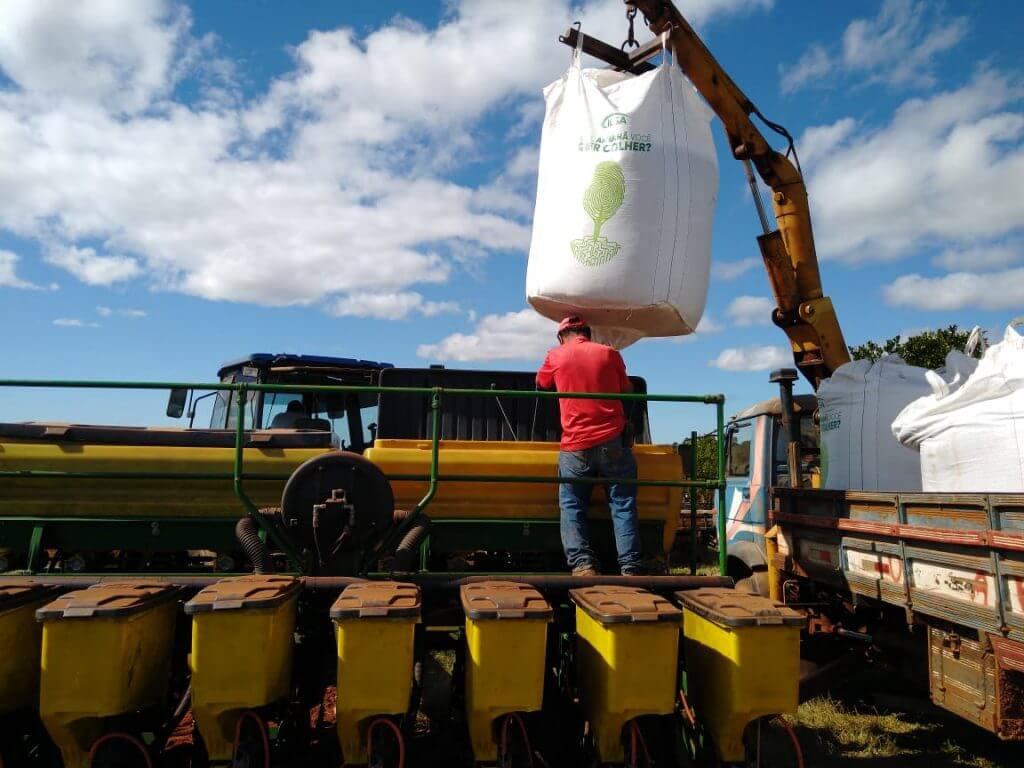
Potassium applied in rows at planting time should be placed approximately 5-7 cm to the side of the seed and 2-5 cm below it. It is important to remember that, as previously mentioned, no application method should allow direct contact between the potassium and the seed to avoid complications.
ILSA is a company specializing in the production of high-performance fertilizers, with over 60 years in the market. Currently, it offers a line of organomineral fertilizers, GRADUAL Mix. This line is composed of an organic matrix called AZOGEL, which consists of 16 amino acids and is based on collagen extracted from cattle, obtained through a highly sustainable process called thermal hydrolysis, plus a portion of minerals, forming a mixture of granules.
The Gradual Mix® fertilizer line has several formulations to adapt to different situations. In soils with a minimum amount of potassium, that is, from 3 to 5% of potassium in the CEC, without the need to add this nutrient in the base fertilization, we have two fertilizers... Gradual Mix 6-24-00 Gradual Mix 12-24-00.
For soils requiring fertilization with a small amount of potassium, there are other formulations such as GRADUAL Mix 10-18-7, which provide low concentrations of potassium to prevent initial deficiency and, simultaneously, to prevent salinity resulting from an excess of this mineral.
In addition to these situations, for topdressing applications requiring a combination of nitrogen and potassium content, we offer the GRADUAL Mix 14-00-14 formulation.
Regardless of the situation, ILSA Brasil's GRADUAL Mix line has the right fertilizer for your crops. The advantages, already recognized and proven, are numerous, such as: the gradual release of nitrogen mediated by the action of microorganisms, allowing for better vegetative development and a natural reduction in plant lodging; greater availability of nutrients for plants; improvement of soil micro and macrofauna; increased plant resistance due to the matrix composed of natural amino acids; and consequently, a greater financial return on investment.
Authors:
- Agricultural Eng. MSc. Aline Tramontini dos Santos
- Agricultural Engineer Ana Elisa Velho
- Agricultural Eng. MSc. Thiago Stella de Freitas
Bibliographic references
- CASTOLDI, G. et al. Fertilization management in no-till systems. Tropical Journal – Agricultural and Biological Sciences, v. 6, n. 1, p. 62-74, 2012.
- CAVALINI, PF; SEVILHA, A.; CRUZ, RMS da; ALBERTON, O. Response of soybeans to potassium application times in topdressing. Arch. Sci. Vet. Zool. UNIPAR, Umuarama, v. 21, n. 1, p. 23-28, 2018.
- MALAVOLTA, E. Potassium and the plant. Piracicaba: POTAFOS, 1982. 61 p. (POTAFOS. Technical Bulletin, 1).
- MALAVOLTA, E.; USHERWOOD, NR. Fertilizers and potassium fertilization. Piracicaba: POTAFOS, 1982. 56 p. (POTAFOS. Technical Bulletin, 3).