


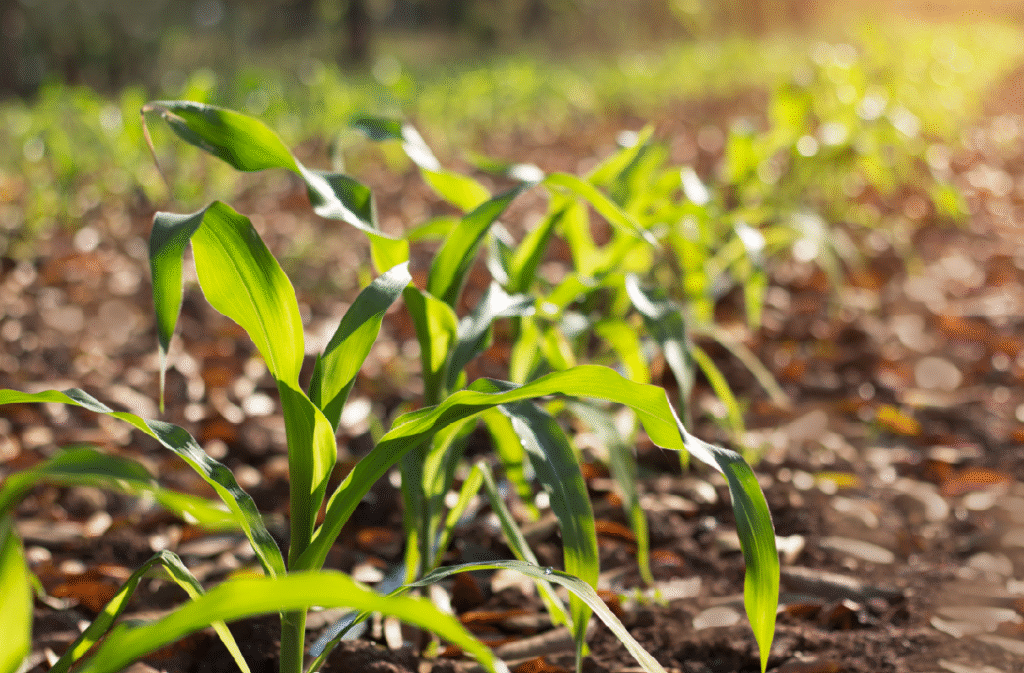
Corn is one of the most nutrient-demanding crops, and therefore, proper fertilization management is one of the main factors determining the crop's productive potential. Nutrient use efficiency depends not only on the quantity applied, but also on the source used, the timing and method of application, as well as the interaction with soil conditions, climate, and management practices. Practices that promote efficient nutrient use include crop rotation, the integration of organic and mineral sources, reduced soil disturbance, the use of cover crops, and, above all, synchronization between nutrient supply and the crop's peak nutrient demand phases (Van Ittersum et al., 2025).
The success of corn fertilization depends on the balance between nutrients, ensuring that each one is available at the right time to support growth and grain productivity. Among the essential macronutrients, nitrogen (N) is the most required and the most exported by corn grains (Table 1). It actively participates in the formation of proteins, enzymes, nucleic acids, and chlorophyll, being fundamental for vegetative growth and biomass accumulation (Taiz et al., 2017). However, it is also a nutrient highly susceptible to losses, whether by volatilization, leaching, or denitrification, potentially reaching 40–78% under inadequate management conditions (Cabezas et al., 2000). Organomineral fertilizers have stood out for combining the agronomic potential of mineral sources with the benefits of organic fertilizers, bringing improvements in soil structure and gradual release (Malaquias et al., 2017). This combination favors growth and biomass allocation in the aerial part, as it promotes a more balanced supply of nutrients throughout the crop cycle (Pereira et al., 2020).
Table 1. Requirement and extraction of N, P and K for the production of 1 ton of corn grain. Adapted from Andrade et al. (2023).
| Nutrient | Requirement (kg/t) | Extraction (kg/t) |
| Nitrogen (N) | 16,9-23,8 | 9,1-13,8 |
| Phosphorus (P) | 2,7-4,5 | 2,3-3,7 |
| Potassium (K) | 14,0-20,4 | 3,5-4,9 |
Phosphorus (P) is another essential nutrient for corn performance, acting in energy transfer (ATP), nucleic acid formation, and root development (Taiz et al., 2017). In highly weathered tropical soils, P availability is naturally limited due to its fixation in iron and aluminum oxides, which reduces its use efficiency (Almeida et al., 2016). Strategies such as no-till farming, organic matter accumulation, and the use of more soluble sources are fundamental to increasing the availability of this nutrient. Furthermore, the use of solubilizing microorganisms has proven effective in improving phosphorus uptake by plants.
Potassium (K) is the nutrient most associated with osmotic balance, stomatal regulation, and photoassimilate translocation, playing a direct role in tolerance to water stress and grain filling (Taiz et al., 2017). K deficiency can compromise sugar transport and plant vigor, resulting in shriveled grains and lower productivity. Conversely, a balanced supply of this nutrient favors water use efficiency and disease resistance, reflecting in greater productive stability in environments with high evaporative demand. Potassium is the second most required macronutrient by corn plants, similar to N (Table 1). Thus, evaluating corn crops, it was identified that the dose of K2This is among the main factors that differentiate the management of high and low productivity crops (Figure 1) (Pilecco et al., 2024).
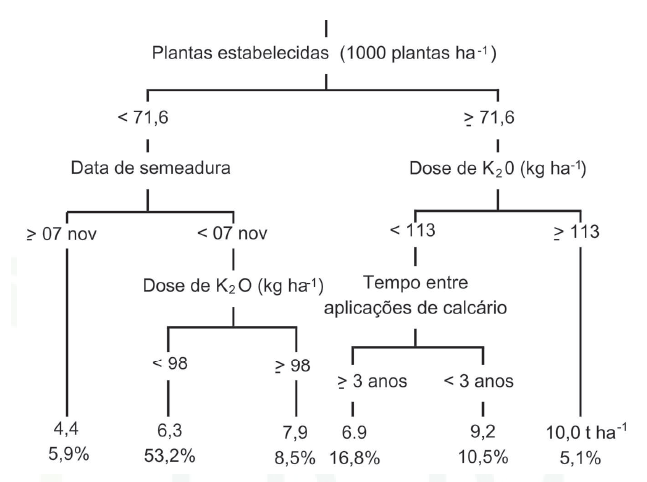
Figure 1. Regression tree diagram for 293 corn crops in Santa Catarina. The terminal branches show productivity and crop percentage. Source: Pilecco et al. (2024).
ILSA Vita fertilizers, such as Gradual Mix 12-09-09 5% S, and ILSA Fert fertilizers, such as Azoslow 29-00-00, are solutions developed by ILSA to improve corn crop nutrition. These formulations use high-quality raw materials and technologies that promote the release of nutrients synchronized with the plant's demands, reducing losses and increasing the efficiency of fertilizer use in the soil-plant system. Gradual Mix contains N, P, and K, as well as amino acids, high CEC, and organic carbon, which confers high biological affinity and contributes to soil health, a fundamental aspect in nutrient management. Azoslow complements the nitrogen fertilization of the crop, providing the most required and exported nutrient by corn plants in a unique way on the market, with immediate and gradual release of the nutrient.
Therefore, fertilizer management should be understood as part of an integrated fertility management system, in which the balance between nutrients, the choice of sources, and the timing of application are crucial for achieving high productivity with sustainability. Innovative technologies, such as slow-release fertilizers, combined with conservation practices, represent an important advance in maximizing nutrient use efficiency and reducing environmental losses. Investing in balanced management and fertilizer technologies is a strategic step for producers seeking to maximize the productivity and sustainability of their crops.
Bibliographic references
Almeida, T. Efficiency of protected phosphate fertilizer in maize cultivation. Scientia Agraria, v. 17, p. 29-35, 2016.
Andrade, FH et al. Ecophysiology and management of corn cultivation. 1st ed. – Balcarce. 2023 486 p.
Cabezas, WAR et al. Balance of solid and fluid nitrogen topdressing in maize cultivation, under no-till system in the Triângulo Mineiro region (MG). Brazilian Journal of Soil Science, v. 24, p. 363-376, 2000.
Cruz, NFFP. Grain productivity and nutrient accumulation in soil fertilized with animal manure during nine growing seasons. 2019. 55 p. Dissertation (Master's in Energy Engineering in Agriculture) - State University of Western Paraná, Cascavel, 2019.
Malaquias et al. Organomineral and NPK fertilization in maize (Zea mays L.) cultivation. v.11, n.5, p. 501-512, 2017.
Pilecco et al. Ecophysiology of maize aiming at high yields. 2nd ed. Santa Maria: Editora GR, 2024. 400p.
Pereira et al. Organomineral and mineral fertilization in the agronomic performance of maize and chemical changes in the soil. Brazilian Journal of Development, v. 6, n. 8, p. 58694-58706, 2020.
Taiz et al. Plant physiology and development. 6th ed. Porto Alegre: Artmed, 2017. 888 p.
Van Ittersum, MK et al. Narrowing the ecological yield gap to sustain crop yields with fewer inputs. Global Food Security, vol. 45, p. 100857, 2025.
Authors
Agr Eng. MSc. Isabela Bulegon Pilecco
Agricultural Eng. Msc. Thiago Stella de Freitas
Agricultural Engineer Tuíra Barcellos