


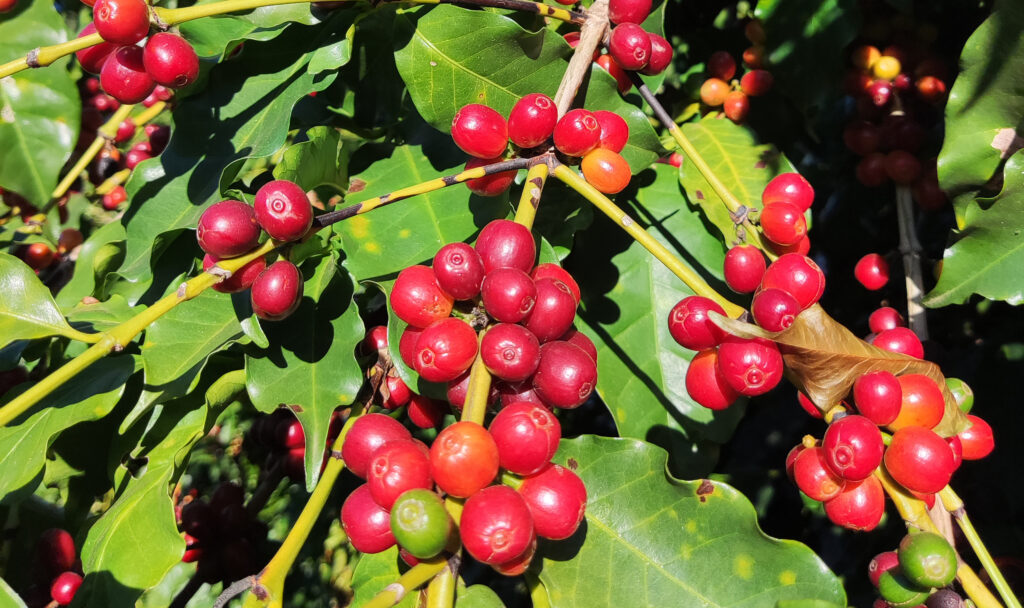
With the growing interest in specialty coffees in major importing markets, maintaining high quality standards has become essential for Brazil to remain competitive and attract new consumers. Among the factors that determine this quality, the nutritional status of the plants plays a central role. Potassium (K) is the second most demanded nutrient by the coffee plant, with a requirement similar to that of nitrogen (N) (Mesquita et al., 2016). Recognized as the "quality element" in plant nutrition, potassium directly influences fruit filling and the formation of well-developed beans, resulting in coffees with better appearance and superior sensory quality.
In addition to stimulating vegetative development, potassium (K) participates in numerous metabolic processes, such as the synthesis of carbohydrates, proteins, oils, and fats, and acts as an activator of more than 50 enzymes (Lima et al., 2003). During fruit filling, this nutrient is essential for the transport of photoassimilates synthesized in the leaves to the grains, regulating the osmotic gradient and sap flow in the phloem (Ross and Nogueira, 2001). This process ensures the continuous supply of sugars and organic compounds necessary for the accumulation of reserves, promoting fuller and more uniform grains. When potassium deficiency is observed, a reduction in grain size, an increase in the proportion of shriveled grains, and a consequent decrease in beverage quality are observed (Malavolta et al., 1997; Silva et al., 2002).
To ensure efficient grain filling, it is important that potassium (K) is available in adequate quantity and at the right time. The nutrient is usually applied in three to four installments, preferably during the rainy season, and adjusted according to water availability. It is recommended to begin applications after the small fruit stage, when the fruit begins to develop, provided there is sufficient moisture in the soil.
In Brazil, potassium chloride (KCl) is the most widely used source due to its low cost. However, depending on the dose and soil conditions, the high chloride ion (Cl⁻) content can negatively affect the nutrition and metabolism of coffee plants, especially since it is a perennial crop with high potassium requirements. In this sense, studies show that the use of chlorine-free sources, such as potassium sulfate (K₂SO₄), provides better quality beans (Silva et al., 2002). Although these sources have a higher cost, the total or partial replacement (minimum of 50%) of KCl with alternative sources, as well as the supplemental foliar application of K, can be beneficial.2ONLY4, have shown positive results in the chemical composition and color of raw grains (Moreira, 2020).
Foliar fertilization is a complementary strategy that provides readily absorbable nutrients, correcting deficiencies and increasing the efficiency of fruit filling. This practice is even more effective when associated with formulations containing micronutrients and amino acids, which favor absorption and plant metabolism (Costa, 2009). In coffee plants, foliar potassium absorption is more intense in the pre- and post-flowering phases, critical periods for fruit formation and filling (Valarini et al., 2005). Thus, foliar fertilization management should be directed towards these stages, ensuring a continuous supply of nutrients for vegetative growth and grain development.
Among ILSA's solutions, ETIXAMIN KALLY stands out. This organomineral fertilizer is composed of the organic matrix GELAMIN combined with potassium sulfate. Potassium is undoubtedly one of the most impactful nutrients for the success of coffee crops during the grain-filling phase. The product combines N, K, S, and amino acids, and can be used via fertigation or foliar application. Thus, it contributes to greater resistance to stress, improved quality and productivity of the coffee plant, acting efficiently in grain filling and improving the final quality of the product. This is an effective strategy to increase coffee productivity and quality, especially under stress conditions or in systems seeking greater sustainability and efficiency in nutrient use.
Bibliographic references
Costa, RA. Mineral fertilizers and amino acids applied via foliar spray in the productivity, vegetative development and nutrition of coffee plants. Master's thesis. Federal University of Uberlândia, Uberlândia, 2009. 57 p.
Lima et al. Effects of foliar fertilization on coffee production and seed quality, Revista Ciência e Agrotecnologia, Special Edition, p. 1499-1505, 2003.
Malavolta, E. et al. Evaluation of the nutritional status of plants. Piracicaba: Potafós, 1997. 319p.
Mesquita, CM et al. Coffee manual: management of coffee plantations in production. Belo Horizonte: EMATER-MG, 2016. 72 p. ill.
Moreira, DT. Effect of potassium source management on coffee productivity and beverage quality. Master's thesis. Agronomic Institute, Campinas, 2020. 59 p.
Ross M., Nogueira F. Nutritional aspects of high quality production of Arabica coffee. In: Horst WJ et al. (eds) Plant Nutrition. Developments in Plant and Soil Sciences, vol 92. Springer, Dordrecht, 2001.
Silva, EBS et al. Quality of processed coffee beans in response to potassium fertilization. Scientia Agricola, v.59, n.1, p.173-179, Jan./Mar. 2002.
Valarini, V. et al. Macronutrients in leaves and fruits of short-stature Arabica coffee cultivars. Bragantia, v. 64, n. 4, p.661-672, 2005.
Authors
Agr Eng. MSc. Isabela Bulegon Pilecco
Agricultural Eng. Msc. Thiago Stella de Freitas
Agricultural Engineer Tuíra Barcellos