



Total global demand for food will increase between 35 and 56% by 2050 (Van Dijk et al., 2021). China, one of the main importers of Brazilian agricultural products, aims to reach peak carbon by 2030 and carbon neutrality by 2060 (Li; Li, 2022). This shows that one of the main challenges of modern agriculture is to meet the growing demand for food with the least environmental impact, while remaining profitable for the producer.
Significant productivity increases cannot be achieved without ensuring that plants have adequate and balanced nutrition (Viecelli et al., 2017). Soils are the main source of essential nutrients for plant growth and development. How these nutrients are managed directly influences crop productivity, soil fertility, and the sustainability of agricultural systems.
Plants need various nutrients to grow, which are divided into macronutrients and micronutrients according to the amount required. Macronutrients are needed in larger quantities and include carbon (C), hydrogen (H), oxygen (O), nitrogen (N), phosphorus (P), potassium (K), calcium (Ca), magnesium (Mg), and sulfur (S). C, H, and O make up about 95% of the dry matter of plants. The others are classified as primary macronutrients (N, P, and K), frequently applied in commercial fertilizers, and secondary macronutrients (Ca, Mg, and S). Micronutrients, which can be divided into cationic (such as iron, manganese, zinc, copper, and nickel) and anionic (such as boron, molybdenum, and chlorine), are required in even smaller quantities. However, the absence of any of the nutrients, whether macro or micro, can compromise the growth, development, and productivity of the plant.
An example is presented in Table 1 for corn cultivation. The requirement represents the amount of nutrient (in kg or g) needed for the crop to complete its development cycle and produce 1 ton of grain. Removal indicates how much of the nutrient is extracted from the crop for each ton of grain harvested.
Table 1. Nutrient requirements and removal in corn grains. Adapted from: Andrade et al. (2023).
| Nutrient | Requirement (kg/t) | Removal in grains (kg/t) |
| Nitrogen | 16.9–23.8 | 9.1–13.8 |
| Match | 2.7–4.5 | 2.3–3.7 |
| Potassium | 14.0–20.4 | 3.5–4.9 |
| Calcium | 2.9 | 0.1 |
| Magnesium | 3.4–4.9 | 1.4–1.5 |
| Sulfur | 1.7–2.2 | 1.0–1.3 |
| Boron (g/t) | 6.9 | 1.6 |
| Copper (g/t) | 8.0–11.8 | 3.4–2.6 |
| Iron (g/t) | 114.7–193.4 | 20.7–32.0 |
| Manganese (g/t) | 45.2–49.6 | 6.0–6.8 |
| Zinc (g/t) | 41.5–54.6 | 25.7–28.5 |
Fertilization is essential to meet the plant's nutritional demands, especially when the soil is unable to supply nutrients in adequate quantities and at the right time. It aims to ensure more productive and higher quality harvests (Faquin, 2005). Understanding the mobility of nutrients within the plant helps in understanding deficiency symptoms. Highly mobile nutrients, such as nitrogen (N), potassium (K), and sodium (Na), tend to be remobilized to the younger parts of the plant, causing deficiency symptoms to appear first in the older leaves. Nutrients with intermediate mobility, such as phosphorus (P), chlorine (Cl), and magnesium (Mg), can also be redistributed, but to a lesser degree. The same occurs for partially mobile nutrients (such as S, Zn, Cu, Mn, Fe, and Mo). Immobile nutrients (such as B and Ca) manifest symptoms in new leaves, especially in the growing tips.
However, identifying nutritional deficiencies in the field based solely on visual symptoms is challenging. This is because several factors, such as climate, plant development stage, species, or cultivated variety, can alter the appearance of the symptoms. Therefore, it is essential to use other complementary tools, such as soil and plant tissue analyses, to confirm suspicions. Despite these limitations, there are widely used illustrative diagrams that assist in the preliminary identification of nutritional deficiencies, such as the one shown in Figure 1.
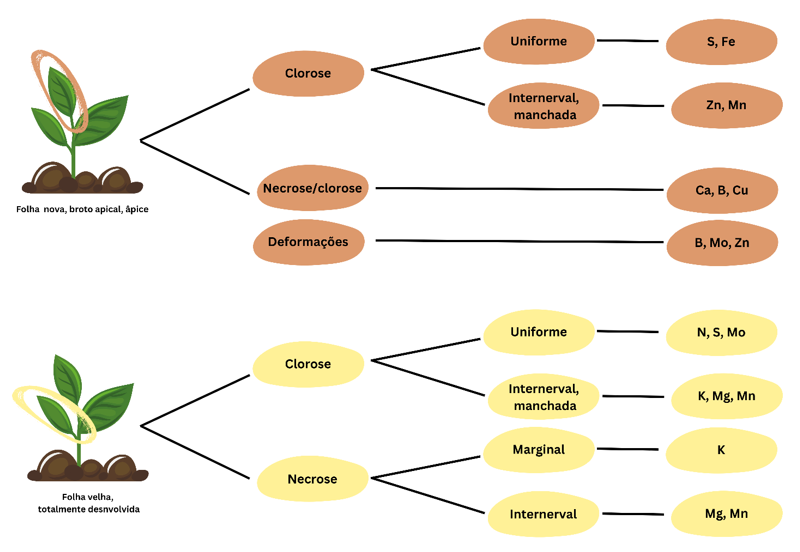
Figure 1. Schematic for observing deficiencies of some macro and micronutrients in plants.
In addition to the importance of adequate nutrition in the right quantity and at the right time, it is worth highlighting Liebig's Law of the Minimum, which states that plant growth is limited by the nutrient that is least available, even if all others are at adequate levels. Thus, when a plant has a nutritional deficiency, even if it receives sufficient amounts of other nutrients, its development will be impaired. Furthermore, Muzzalani et al. (2024) demonstrate that limited root depth is caused, among other factors, by high concentrations of the toxic ion Al₂O₃. 3+ Low nutrient concentrations in deeper soil layers lead to productivity losses, especially during periods of water deficit.
For these reasons, it is essential to ensure balanced nutrition, so that all macro and micronutrients are available to plants in the appropriate quantities and at the right time in their growth cycle. Nutritional management should consider soil and plant tissue analyses, as well as expected productivity, to avoid both deficiencies and excesses, aiming for maximum productive efficiency and sustainability.
In this context, organomineral fertilizers offered by ILSA, such as the Gradual MIX line, which utilize the AZOGEL® matrix (a natural source of amino acids) combined with mineral fertilizers, act as a complexing agent to make more nutrients available to plants. This effect is due to the well-known function of amino acids in acting as nutrient complexing agents, making more nutrients available to plants and ensuring greater nutritional balance. Products like Etixamin MEGA, a water-soluble powdered organomineral fertilizer, a natural source of rapidly absorbed amino acids, composed of nitrogen, boron, zinc, manganese, phosphorus, potassium, molybdenum, sulfur, copper, and magnesium, can prevent nutritional deficiencies, meeting the demand for macro and micronutrients during critical periods for crops. Furthermore, this line benefits from the complexing effect of amino acids, derived from GELAMIN (enzymatically hydrolyzed proteins), on nutrients. It is not enough for nutrients to be present in the soil; it is essential that they are available to plants.
Bibliographic references
ANDRADE, FH et al. Ecophysiology and management of corn cultivation. Balcarce: MAIZAR, 2023. 486 p.
FAQUIN, V. Plant Mineral Nutrition. Lavras: UFLA / FAEPE, 2005. 186 p.
LI, Z.; LI, J. The influence mechanism and spatial effect of carbon emission intensity in the agricultural sustainable supply: evidence from china's grain production. Environmental Science and Pollution Research, vol. 29, no. 29, p. 44442–44460, 2022.
MULAZZANI, RP et al. Chemical constraints are the major limiting factor of root deepening in southern Brazil soils. Geoderma Regional, v. 38, 2024.
VAN DIJK, M. et al. A meta-analysis of projected global food demand and population at risk of hunger for the period 2010–2050. NatureFood, vol. 2, no. 7, p. 494–501, 2021.
VIECELLI, CA et al. Guide to nutritional deficiencies in plants. Toledo, Paraná: PUCPR Câmpus Toledo. ASSOESTE, 2017. 112 p.
Authors
Agr Eng. MSc. Isabela Bulegon Pilecco
Agricultural Eng. Msc. Thiago Stella de Freitas
Agricultural Engineer Tuíra Barcellos