

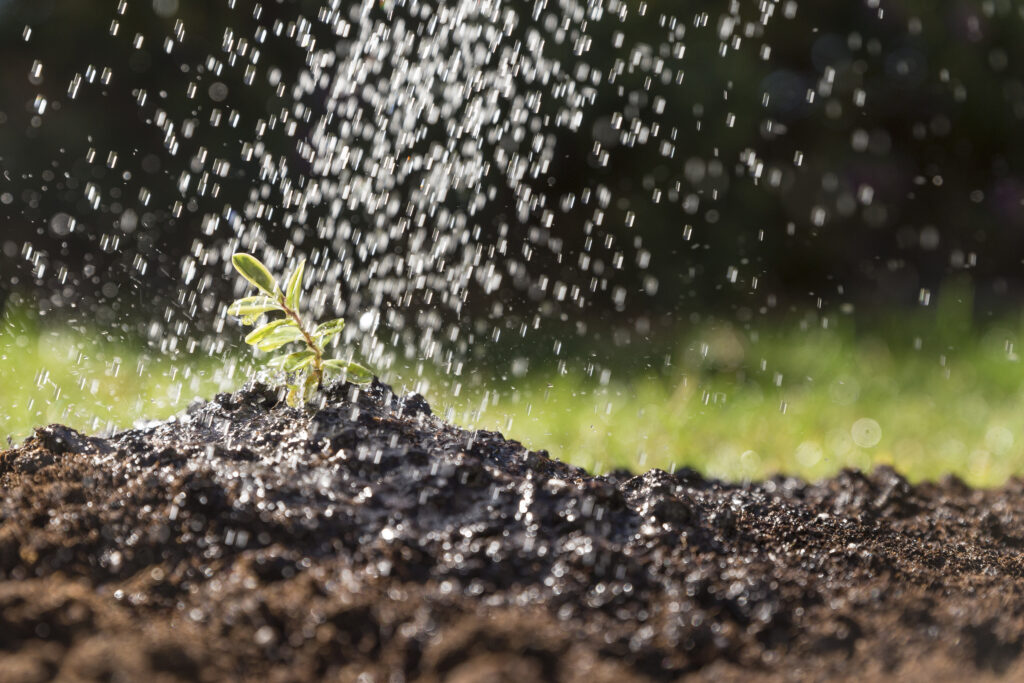
Water stress and low soil fertility are among the main limiting factors for the productivity of agricultural crops (Cakmak, 2005). Irrigation, therefore, is one of the most effective agricultural practices for increasing crop productivity. In irrigated systems, where there is greater productive stability and higher investments, nutritional management becomes even more relevant. In this context, fertigation is an alternative with technical and economic advantages compared to conventional fertilization methods (Sousa et al., 2011).
Fertigation consists of applying fertilizers diluted in irrigation water, promoting the rational use of inputs. When well executed, it provides high uniformity of distribution and greater efficiency in nutrient application, reducing losses due to leaching and percolation (Borges, 2009). Another great benefit is the possibility of splitting the doses, allowing the supply of nutrients at the appropriate time in the crop development cycle (Borges, 2009). This technique is especially recommended in localized irrigation systems, such as drip and micro-sprinkler irrigation (Borges et al., 2006).
To achieve the maximum potential of fertigation, it is essential to adopt certain precautions, including chemical soil analysis. Knowing the soil and the crop's needs is crucial for defining the quantities, frequency, and concentration of applications, as well as the time between them. Continuous monitoring of nutrient availability is also important to ensure balance in the soil solution, avoiding both deficiency and excess, which can increase the osmotic potential and salinity of the soil solution, favoring losses through leaching (Borges et al., 2006).
Other important factors include evaluating the pH of the nutrient solution, which should be between 5.0 and 6.5, since pH values above 7.5 can cause precipitation of calcium and magnesium carbonate, clogging the irrigation system emitters (Borges et al., 2006). It is also essential to consider the electrical conductivity of the water, maintaining it between 1.44 and 2.88 dS/m to avoid soil salinization (Borges et al., 2006). Water temperature also directly influences fertigation efficiency, and should be close to 20 °C, as lower temperatures reduce fertilizer solubility (Borges, 2009).
Choosing the right fertilizer is a fundamental factor for successful fertigation. Formulations must have high solubility, ensuring the expected concentration in the solution, as well as adequate compatibility between macro and micronutrients in the mixture (Borges, 2009). ILSA offers efficient solutions for fertigation, notably Etixamin KALLY, Etixamin DF, and Etixamin MEGA.
Etixamin KALLY contains GELAMIN and potassium sulfate, making it an excellent source of organic nitrogen, potassium (K), and sulfur (S), ideal for late-cycle applications. Etixamin DF has 16% of N exclusively from GELAMIN and holds Ecocert certification, attesting to the product's sustainability. Etixamin MEGA, on the other hand, has a wide variety of macro and micronutrients in its composition. This product is an advanced example of a specialized fertilizer that combines the benefits of amino acids with a balanced formulation of macro and micronutrients, providing complete nutrition and anti-stress effects in a single application. Etixamin MEGA provides complete nutrition – containing primary macronutrients (NPK), secondary macronutrients (Mg, S), and micronutrients (B, Cu, Zn, Mo) essential for plant metabolism. The amino acids act as complexing agents, facilitating the assimilation of minerals and providing better nutrient absorption.
In Etixamin MEGA, nitrogen comes from GELAMIN and monoammonium phosphate (MAP). MAP provides readily available ammoniacal nitrogen (NH₄⁺), while the organic N from GELAMIN is mineralized by soil microbial activity, being converted into ammoniacal and nitric forms (NO₃⁻), which are assimilable by plants. This combination favors the cation-anion balance in the soil solution, since each form of N influences the pH of the rhizosphere differently: nitrate tends to alkalize, while ammonium has an acidifying effect. Considering these interactions is essential, as an excess of certain ions can restrict the absorption of other essential nutrients.
Table 1 presents the compatibilities between fertilizers commonly used in fertigation. For mixtures not listed in this table and with unknown compatibility, it is recommended to perform the "jar test," in which the fertilizers are mixed in actual proportions in a jar and left for about two hours. The absence of precipitates indicates the viability of the mixture for use in the system (Borges, 2009).
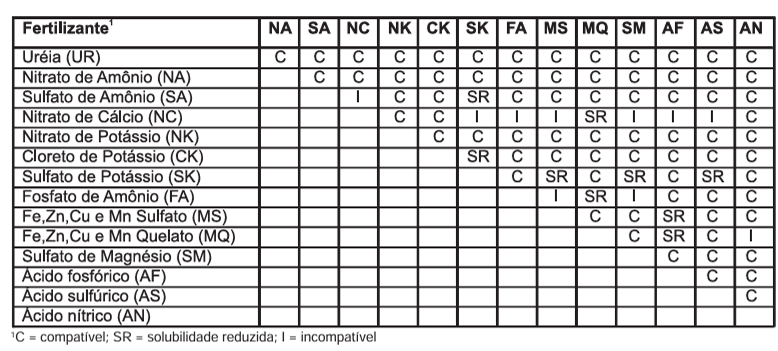
Table 1. Compatibility between fertilizers used in fertigation. Source: Borges (2009).
Fertigation is a practice that directly contributes to managing the two main limiting factors of agricultural productivity: water deficit and nutritional deficiencies. When well-planned and executed, it can optimize the use of water and nutrients. Increasing the efficiency of fertigation requires attention to water quality, fertilizer selection and compatibility, soil characteristics, and crop requirements regarding water and nutrients. With these precautions, in addition to improving crop performance, fertigation can add value to the product, promoting more profitable, nurtured production systems aligned with the principles of sustainability and rational use of inputs. ILSA offers innovative solutions that combine high-quality amino acids (from the exclusive organic matrix GELAMIN®) with essential plant nutrients, as in the case of Etixamin MEGA.
Bibliographic references
Borges, AL Fertigation of Banana Plants. Embrapa, Technical Circular, no. 84, 2006.
Borges, AL. Fertigation in tropical fruit trees. 2nd ed. Cruz das Almas: Embrapa Mandioca e Fruticultura Tropical, 2009. 179 p.
Cakmak, I. Role of mineral nutrients in tolerance of crop plants to environmental stress factors. In: Proceedings from the International Symposium on Fertigation – Optimizing the utilization of water and nutrients. Horgen: International Potash Institute, 2005. p. 35-48.
Sousa, VF et al. Irrigation and fertigation in fruit and vegetable crops. Brasília: Embrapa Informação Tecnológica, 2011. 739 p.
Authors
Agr Eng. MSc. Isabela Bulegon Pilecco
Agricultural Eng. Msc. Thiago Stella de Freitas
Agricultural Engineer Tuíra Barcellos